The Call
In those days I usually worked from home, showing up at the office with reports once a week, on Thursdays. All the stranger, then, was the insistent phone call that woke me at eight in the morning on a Monday. My project curator demanded my immediate presence at the office, his tone unexpectedly icy and threatening.
By the time I woke up I’d been asleep for maybe three hours. My head was loose, frightened, and disconnected from the rest of me, like a Chinese tourist who’d missed his bus.
I chalked up the perceived threat in my boss’s tone to my own morning paranoia, and to the fact that European intonation patterns weren’t exactly native to him.
I kissed my new girlfriend on her large, round, freckled shoulder, jumped on my beloved Yamaha DT-1 (a replica, of course) and tore off for the office.
Rationally speaking, I had absolutely nothing to fear. I was what’s called a star performer. At that point I’d already built a second product for the company. My first project had turned out very well. They held me up as an example to the sorry excuse for young talent we had, and even invited me, as a technical consultant, to sit in on board meetings.
In fact, about the only thing anyone could ever scold me for was not humming the company anthem while I worked. So I really wasn’t all that worried.
One peculiarity of doing business in Asia is that when your boss wakes you up out of nowhere and demands you come to the office, you don’t ask “why?” You just get where you’re told, as fast as possible.
As I walked past the security guard, he sniffed at me pointedly, and I realized I’d meant to shower and hadn’t. I must have reeked for miles of an all-night bout of love mixed with burning wormwood.
I was lucky enough to have the elevator to myself. It was still too early. The building wouldn’t really come to life until around ten, and it wasn’t even half past eight yet…
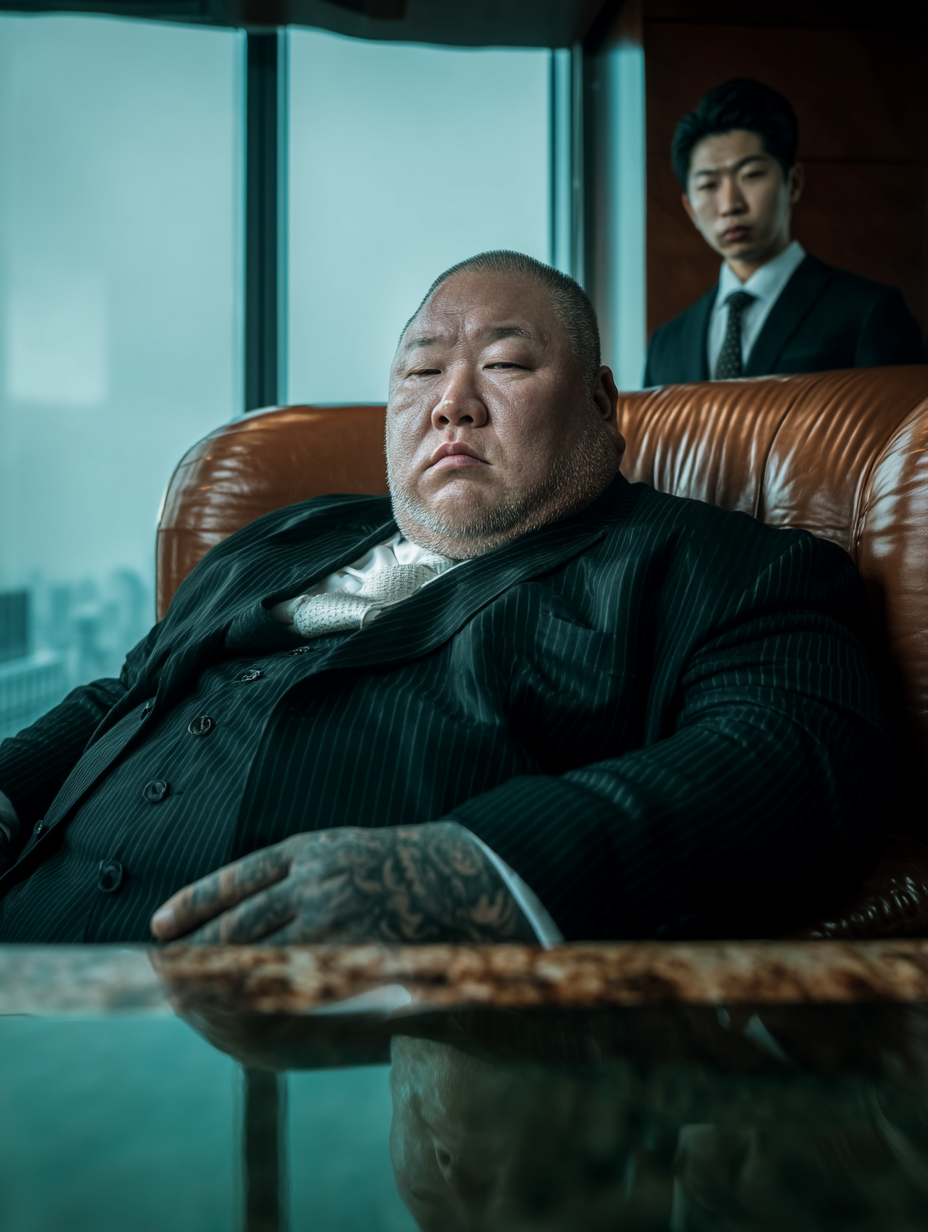
At last I walked into my curator’s office. My curator was standing to the right of his own desk, while behind that desk sat, probably, the single most repellent person I’d ever seen at any board meeting I’d attended.
He was impossibly fat and looked like a large, unappetizing, pale rice pudding. His head was shaped like some gelatinous deep-sea fish hauled up onto the shore. Interestingly, he actually smelled like that fish. His fingers bore tattoos of blue rings. He stared at me with the small, hard eyes of a Black Sea goby, and said nothing.
I said hello. No one answered. The two of them just kept staring at me.
There was a free chair by the desk. But I decided my curator would take it badly if I sat down while he was standing. So I simply shut the door behind me, settled into a relaxed but not insolent stance, and waited for management to finish looking me over.
“So, what were you doing yesterday?” my curator began.
“My personal life,” I said. “Yesterday was my day off. Sunday.”
“We happen to know you weren’t only occupied with personal matters.”
“What do you mean?”
“Yesterday you were coding, and writing a piece of popular-science writing.”
“Yes. I use my personal time for professional self-improvement and technical experiments. And writing is my hobby. All of that is my own business. The same as a date, or going out to a restaurant, for instance…”
“Our company’s management finds your hobby undesirable. We’re demanding that within twenty-four hours you destroy both your code and the article about it.”
You cheeky little runt, I thought at that moment. My curator came up to about my chest, and honestly he didn’t look fat so much as what you’d call chubby. You know, a Gangnam cherub.
Sometimes the paranoia induced by, well, you know what, combined with sleep deprivation, suddenly flips into its opposite. Into a fierce, reckless courage that makes your face burn and your heart pound with something close to joy.
“It seems to me that no one in this world is in a position to demand anything of the sort from me,” I said, shaking my head from side to side and grimacing. “The right to self-development and to a hobby is my fundamental human right. If my personal life is a problem for this company, I’m prepared to be fired.”
My head was working very fast in that moment. I’d already weighed everything up. On the right, gleaming with sharp edges, loomed my career and my reputation, while on the left stood, more modestly, blogging, my indie projects, sex, the flute, and shōjo manga. Between these two clusters of things lies a little blue ribbon meant for a bow, and the line marked out by that ribbon needs to be sturdier and less permeable than the Western Wall.
On the other hand, I couldn’t really say I loved my life in Seoul. Seoul was better than Delhi or Moscow, where I’d lived and worked before. But I’d long dreamed of living somewhere with an eternal summer climate, near warm water, close to a rainforest, a waterfall, and all that other “beauty outside the body.” The flute and the no-strings-attached sex I’d used to warm my weary soul in Seoul over the past two years had started to wear thin.
My contract had a clause requiring me to live no more than half an hour from my curator’s office. Bringing up the renegotiation of individual contract clauses simply isn’t done, in Far Eastern tradition.
My savings would cover about a year and a half of a perfectly decent life in Asia with no work at all. Of course, I’d have to move out of my two-bedroom condo in Cheongdam into something more modest. But hell, if I quit, I wasn’t spending another day in this South Korea I was sick to death of. A wild boyish hunger for new adventures was rising in me, and quitting seemed like a magnificent excuse to set it off.
I looked at both bosses’ faces and saw they were seriously thrown. They simply hadn’t expected any pushback from me. In Korea — and pretty much everywhere in East Asia — an employee who gets told something in a hard, categorical tone falls in line a hundred percent of the time.
Well hello there, shorties — I said to myself, meaning by “shorties” the White Moroccan Dwarfs — looks like the ball’s in my court now. I couldn’t have imagined, at that moment, just how right I was about that ball.
“Wait here,” said my curator, and left the room together with the sperm whale guy, a former street thug.
I assumed they’d gone off to confer about what to do with me. For a split second, the tail-end of some rat-like fear flickered across my mind. I got briefly scared that they might actually kill me. But the idea itself — that I’d get taken out over an unpublished Habr article about a homemade indie game — was so absurd that it suddenly became almost interesting to see how it would play out.
Still, I didn’t sit down on the chair to wait for management. No point tempting fate before it’s due.
Less than ten minutes later, the bosses came back. Not both of them. My curator came back. Robin Bobin from the upper floors had vanished into the wings.
“Let’s approach this from another angle,” the manager began. “Under what conditions would you agree to destroy the results of the work in question, and never go back to that line of work again for the foreseeable future?”
“See, here’s the thing…” — while they’d been out, I’d had plenty of time to work out my price and my terms, and now I was just playing it up a little, acting the impractical dreamer — “you want to set me a condition that lasts my whole life. Is that right?”
“Yes. Exactly that. We want you to avoid working in this area for your entire life.”
“But there’s also a material component. Meaning, finished code, and an article that’s almost done” (here I was lying a little; I’d barely finished half of it) “…and since my product has two components — it has a material part and a lifelong agreement — the compensation should also come in two parts. A one-time payment, and a lifelong one.”
“Let’s assume so.”
“As the one-time payment, I want a small island in a climate zone of eternal summer. An island of about four to six square kilometers. Fresh water, a good ecosystem, clean, uninhabited. I need a ninety-year lease on that land in my name. That’s usually the only form of ownership available to a foreigner for that kind of property. And as the ongoing part of the compensation, I want two hundred thousand dollars a year for life, paid out in monthly installments… I’m sure that’s an acceptable price for you.”
“Yes, that’s acceptable,” my curator answered, so quickly it was as if he had a ticking time bomb lodged in his rectum. Though who knows — maybe he really did. Why else would they have stepped out, and why would only he have come back?