Olokun's Son-in-Law
Del and I spent the next couple of months here on the island — exceptionally happy and serene ones. I did practically no work at that time. Robert and Alexei took the running of the island household upon themselves, giving me the chance to savour domestic bliss to the full.
But time went on, and Delphine recalled more and more often that she would like to introduce me to her parents. I decided to turn meeting my wife’s family into a separate adventure.
By that time the first sales of our “marine Wi-Fi” had got off to a good start, and there turned out to be unexpectedly much free money about. I decided to travel by sea to the coastal village where Del had grown up.
I chartered a small but thoroughly ocean-going sailing yacht. A captain came with the little vessel. It was the very end of November. In our latitudes the storms had only just settled down.
We sailed away from the morning island in a sweet, warm, thick fog. I remember well how my heart ached with the sense that Delphine’s path and mine had slipped once again into the dusky, fragrant valley of the unfulfilled.
The voyage did not turn out to be especially rich in events. Sometimes we met dolphins. Sometimes flying fish. A couple of times we spent the night in a tent ashore.
Several islands lay along our way. I hunted with a spear gun among the coral reefs and the underwater rocks and in the evenings fried large Scaridae and Lutjanidae on utterly empty and piercingly picturesque beaches. The wind worried the flame of our little fire, sharpening to an almost unbearable keenness that particular sense of welcoming homelessness which can be experienced only on a wholly empty earth.
There were a multitude of ocean sunsets. Of huge, shallow-sloping waves. Of dazzling sky. Of fantastical clouds. There was the cartoonish, unreal cosiness of a tiny, warmly lit shell in the midst of a boundless, dove-grey, stirring nocturnal space.
I remember that throughout the voyage we listened constantly to “Wallflower” by Diana Krall. I sat with my elderly PocketBook in a deckchair on the stern, against the background of the boundless ocean, or enjoyed Delphine’s company. We talked a very great deal then. We still had plenty of undiscussed subjects left.
Some ten days later our little vessel dropped anchor in a flat, wide bay. A monotonous dove-grey sandy beach ran away in both directions as far as the eye could see. Monotonous and empty. Riotous forest began some fifty metres from the water’s edge. Right in front of us long fishing boats lay on the sand, and simple single-storey plywood houses on stilts, red and blue, huddled together. Even a hundred metres from the shore there was a smell of salt fish and rotting seaweed. This was the village where Del was born.
“Meeting the parents” turned out to be a fairly exhausting business for me. In the village nobody apart from the school-age children spoke English. I was led from one place to another. Things were shown to me. Things were explained at length. I understood absolutely nothing. But I smiled and nodded.
At first Del tried to translate for me the endless stream of congratulations and assurances of respect, but she soon gave it up, carried away by talking with relatives she had not seen for a very long time.
We were given a spacious and relatively clean little house to sleep in. I felt rather like a highly respected hatbox from overseas in that motley company of cheerful, passionate, beautiful and simple people. In the end I said that I urgently needed to get in touch with a client, and hid myself away on the yacht. In the evening a boat was sent for me. The family had organized a feast in our honour.
The feast took place in the special house for all-family gatherings. In a large boarded building without any windows at all, lit by three bare bulbs, outrageously dusty and fly-specked. The place was permeated through and through with something alcoholic, with tropical sweat, tobacco, distinctive food and, like everything else in that village, fish.
The whole floor in the middle of the room was covered with all sorts of victuals and drink. The feasters sat pressed close to one another. Cross-legged and on their haunches. Delphine was seated between her parents, and I found myself squeezed tightly between two muscular, black, tipsy young men. The only clothing on them was denim shorts.
I, as ill luck would have it, had put on soft linen trousers. For some reason it seemed to me that if the natural reaction of my loins gave away my secret interest in my neighbours at the table — that would be an utter disaster. Obviously I had invented this for myself. As it turned out later, this little people’s amorous customs were of the most progressive kind.
So as not, God forbid, to betray my interest in the young olive bodies pressing me from both sides, I began to study the interior of the room intently.
There was much of all kinds in that room. In the far right corner from where I sat there was a sort of “music corner”. On a low homemade table lay a very old inanga, its varnish worn away by the palms of several generations of musicians. Behind it stood batá, a djembe and a kpanlogo. Vertical battens with nails driven into them were fixed to the wall, and on these hung two ndongos, three valihas and a multitude of kessings, udus, sistrums and shekeres.
At that time I did not yet know the names of all these intricate musical instruments. I learned them later, here on the island. Del’s relatives earned money in part by making music at fairs and weddings. This brought in a negligible amount, but gave them great pleasure. Plus musicians were often plied with free drink.
Practically this entire “family ensemble” has now moved over to us on the island. And this evening you will most certainly hear it. A little further along the wall hung two very old hunting guns in excellent condition. If Del’s relatives understood the value of antique weapons, they could easily have got the price of a new top-of-the-range iMac for each of those guns.
Further on hung paintings. There were many of them, and all of them, beyond any doubt, came from my wife’s brush. Judging by a certain schoolroom awkwardness of stroke and line, they were very early works of hers. Yet it was precisely their naivety that gave them a particular, sharp charm. For a moment I was deeply touched, picturing the serious, frowning adolescent girl daubing away at such a canvas with self-forgetting stubbornness. Presented properly, those pictures would be beyond price.
At last my gaze fell on a stretch of wall entirely covered with photographs. The largest group portrait had been set in a homemade wooden frame. And it was precisely that photograph which changed my mood so completely that for the whole of the rest of the evening I cared nothing for young flesh of any sex.
In the photograph, beneath a large banyan, in broad patches of light, literally the whole family was assembled. There were some thirty people in it. The first row squatted on their haunches. The second stood behind. The villagers formed what looked like two flanks around a central group of four.
In the centre stood an adolescent girl, angular and thin, in torn denim shorts. It was not easy to make out in her the present-day Delphine.
The girl was being held round the shoulder by a stooping black man with the look of a marginal intellectual, in jeans and a T-shirt, in spectacles and with a small beard. In appearance he somehow recalled the well-known dub performer Augustus Pablo.
At the man’s feet, squatting on her haunches, was a sumptuous, very dark diva in a national dress. Her hairstyle was decidedly magnificent by local standards. Heavy and intricate. The lady was very curvy. Mightily, flagrantly feminine. She seemed perceptibly younger than her husband.
These were Del’s father and mother. I had already met them that day. And they really did not look like Del at all. Possibly Del was after all an adopted daughter.
What made me break out in a cold sweat and cry out inwardly was the fourth figure. To the right of the regal family, hands behind his back, standing modestly, was none other than that same fat deep-sea ex-gangster with the tattooed hands. The one who had come to have a look at me in my former handler’s office. In the photograph he looked a great deal younger. And he was not yet monstrously obese then. Evidently his corpulence was to be explained by some progressive illness.
In that photograph the features of his face had not yet run together into a gelatinous, flabby mask, and one might have supposed that by origin he was Japanese rather than Korean.
I was very lucky that Del was far away from me at that moment and that she was not looking at me. The fact that I was wedged in among her tipsy relatives gave me time to come to my senses. If Del had been freely available to me then, it is highly likely that I should have insulted her at once with monstrous suspicions, and very likely that we should have parted afterwards.
Del is a very proud creature. And quite hot-tempered. Besides which, she is much given to taking quick and irreversible decisions. This daughter of the leader of destitute fishermen turned out to possess an unexpectedly large number of the qualities that usually go with being accustomed to power and plenty.
And now let us go into the grotto at last. Everything you need for a correct understanding of the cave installation you have already heard.
Stas Rybkin: Let us. We shall have to take the tripod apart now and carry the camera, because the entrance to the cave is fairly narrow. We shall meet again inside. Lighting has already been rigged in the cave and there is a generator working there. The generator is fairly noisy and the cave is echoing. So I shall switch on heavy noise suppression on the microphone. Our voices may change slightly as a result.
Oleg Batygin: Just now I find myself wondering somewhat why I never did get round to running electricity into the cave.
Stas Rybkin: And do you think it is worth doing? After all, a grotto with a sanctuary is a very archaic sort of object…
Oleg Batygin: Yes. You are probably right. Electric light would kill half the charm of the place.
…………………………….
Stas Rybkin: We are in the grotto. In front of us, in the torchlight, stands a large stone altar. On it are a multitude of offerings. These offerings now have a distinctly masculine character. On the altar one can see a box of good cigars, a bottle of whisky. There are several fairly old men’s magazines. And here too we see several toy motorcars. Very expensive makes. Mercedes, Aston Martin, Lamborghini, Bentley… Beside them a whole collection of porcelain girls… And, good God! A pistol! Is it real?
Oleg Batygin: No. I did not allow them to put a real pistol in here. It is a plastic imitation.
Stas Rybkin: Let us now look at the stone standing upright above the altar. Am I right in understanding that on this stone are the attributes of the deity to whom this shrine is dedicated? A living deity…
Oleg Batygin: Quite right. Del’s relatives consider the man who introduced himself as an employee of a charitable foundation and who helped her and her family for many years to be the incarnation of that same sea deity whom you and I have agreed to call Olokun. As you see, I have written several Korean characters here in hangul. You will remember that this man introduced himself as Byung Min. There is a common Korean name, Byungmin (병민). It means the One Who Changes the World. It sounds highly symbolic. And it is precisely these characters that I wrote here, in a suitably blue phosphoric paint.
Stas Rybkin: The characters look exceptionally mysterious, and I am sure they make an impression on the initiated.
Oleg Batygin: Exactly. The characters went down very well. If you look closely, you will see that many people here place them on women’s jewellery, on clothing, on the walls of their houses, and even have scarification tattoos of that shape.
Stas Rybkin: Are we witnessing the birth of a new religion?
Oleg Batygin: Good heavens, no! This is a very old religion. The cult of the almighty sea king and of his daughter, the begetter of success and wealth, is probably older than the cult of the Anunnaki. According to the beliefs of Del’s relatives, sea deities have a habit of coming out onto dry land in order to “set everything right”, should the need arise. Sometimes they clamber out of the depths simply for amusement.
In their natural form the sea king and his daughter look like out-and-out monsters of the deep. Something between sea serpents and fantastical, many-rayed echinoderms. Del draws a great many of them. You saw one of them as a decorative fresco on the wall of our sitting room.
Which is why the mystical lords of the sea usually travel about on land by taking possession of human bodies. What is interesting is that human bodies are changed by this. And whereas Aje gives the woman who bears her tall stature, physical strength, excellent health and rare good luck, Olokun slowly kills the one who bears him. He does not do it on purpose. That is simply how he is made. Possibly that is precisely why, as though in apology, Olokun endows the man possessed by him with utterly incredible power. He makes him able literally to change the world.
Stas Rybkin: All this sounds frighteningly coherent. The mosaic is coming together… But surely it cannot be that all these ancient fairy tales have turned out to be true?
Oleg Batygin: I myself do not believe in fairy tales. But I love a good narrative. And I prefer not to hobble my mind. Do you remember how it was enough for me to allow myself to believe in telepathy in order to solve the riddle of the “angelic synergy”?
Stas Rybkin: Yes. I remember it perfectly. And did you manage to solve this riddle too?
Oleg Batygin: This riddle is of the sort whose solution consists in understanding that there is no riddle here at all… At the moment when I saw the photograph of Byung Min, Delphine and her family, the first thing I did was to fall into the most toxic paranoia. I supposed that the Korean gangster had been so cynical and so soulless as to plant Del on me. To pay her for the vilest thing that can exist in the world. For the imitation of love…
However, the longer I sat there, breaking out in a cold sweat, in that merry family circle, the more absurd and out of place my suspicions seemed to me.
To begin with, Del did not lift a finger to make my acquaintance. It was I who went up to her. It was I who telephoned her every morning with a proposal to spend another day together. It was I who proposed marriage. Delphine merely agreed.
Del arrived in Ella a week before me. Before setting off for Ella, I had planned to swing by the Dunhinda waterfall first. If I had followed that plan, Del and I would have missed each other. I went straight to Ella simply because an old friend offered me a train ticket at half price. Do you know what goes on with railway tickets in the Kandy–Ella direction? It is an absolute nightmare. They are bought up by speculators a month ahead. Especially in the high season. That railway route is an important tourist attraction. It is incredibly picturesque.
If I suspected Del, then I should have had to suspect a great multitude of the friends and acquaintances I was in contact with at the time as well. The friend from Kandy who offered me the train ticket, for instance.
Our meeting with Del was an unquestionable coincidence. A girl who had always had unusual luck simply had luck once again. In no stranger a fashion than before. But in no less strange a one either…
Stas Rybkin: Am I right in understanding that this large group photograph here, under the piece of Perspex, is the very one that made such a powerful impression on you?
Oleg Batygin: Yes. That is the one. The only scientifically attested full-length image of Byung Min. Below it is a portrait of Olokun by Del. His original, underwater aspect, so to speak. From this angle Olokun resembles a fantastical coloured cactus. Lower down again, on a lectern, stands the magazine with the image of a hand on it, which I bought in a Seoul 7-Eleven.
And then the spectacles. These are the very spectacles through which I saw Byung Min’s hand on the magazine cover. These spectacles are a functioning holy relic. It is believed that through them one can see Byung Min’s “trace”.
The followers of the cult believe that Byung Min alone knows where our world is going. Or rather, the world goes where the Lord of the Ocean goes. Which means that if you see Byung Min’s “trace”, you see the direction in which all things are changing.
When a cultist is at a loss and cannot take a decision, he puts on these spectacles, notices something he had not noticed before, and understands what he is to do next.
Stas Rybkin: Terribly interesting! And may I try? I mean, may I put these spectacles on?
Oleg Batygin: Of course. That is what they are lying here for…
Stas Rybkin: (puts on the spectacles) So… What shall I notice? Oh… I have noticed a gravestone. I had not noticed it before.
Oleg Batygin: It is strange that you did not notice this little monument straight away. It is completely in plain view.
Stas Rybkin: Yes. That seems strange to me too. And, I must admit, I am a little frightened.
Oleg Batygin: There is absolutely nothing here to be frightened of. I think that death is the very last thing this gravestone symbolizes.
Stas Rybkin: So you are inclined after all to listen to this strange oracle?
Oleg Batygin: I find it very hard to believe in the magical power of spectacles bought in a 7-Eleven. But the human mind is a machine for making predictions. The spectacles may simply have been a pretext that your mind made use of in order to tell you something.
Stas Rybkin: My mind made use of that pretext to frighten me… And who is buried here, if it is not a secret?
Oleg Batygin: This is Olivia’s grave. Del invited Olivia to the island in her very first year here. Olivia was still suffering from unbearable loneliness and, naturally, accepted the invitation with delight.
Olivia died a year and a half ago. She had a tumour in her brain which she categorically refused to have removed. The tumour gave her visions. And Olivia could not bring herself to part with them. This is so far the only grave on our island.
I think Olivia was happy here. Del’s relatives venerated her as Olosa, the wife of Olokun. Unlike the formidable ocean god Olokun, Olosa rules over quiet and welcoming lagoons and bays. She is the soft smile of the sea. Olosa drives in the catch, bestows pearls, saves the drowning.
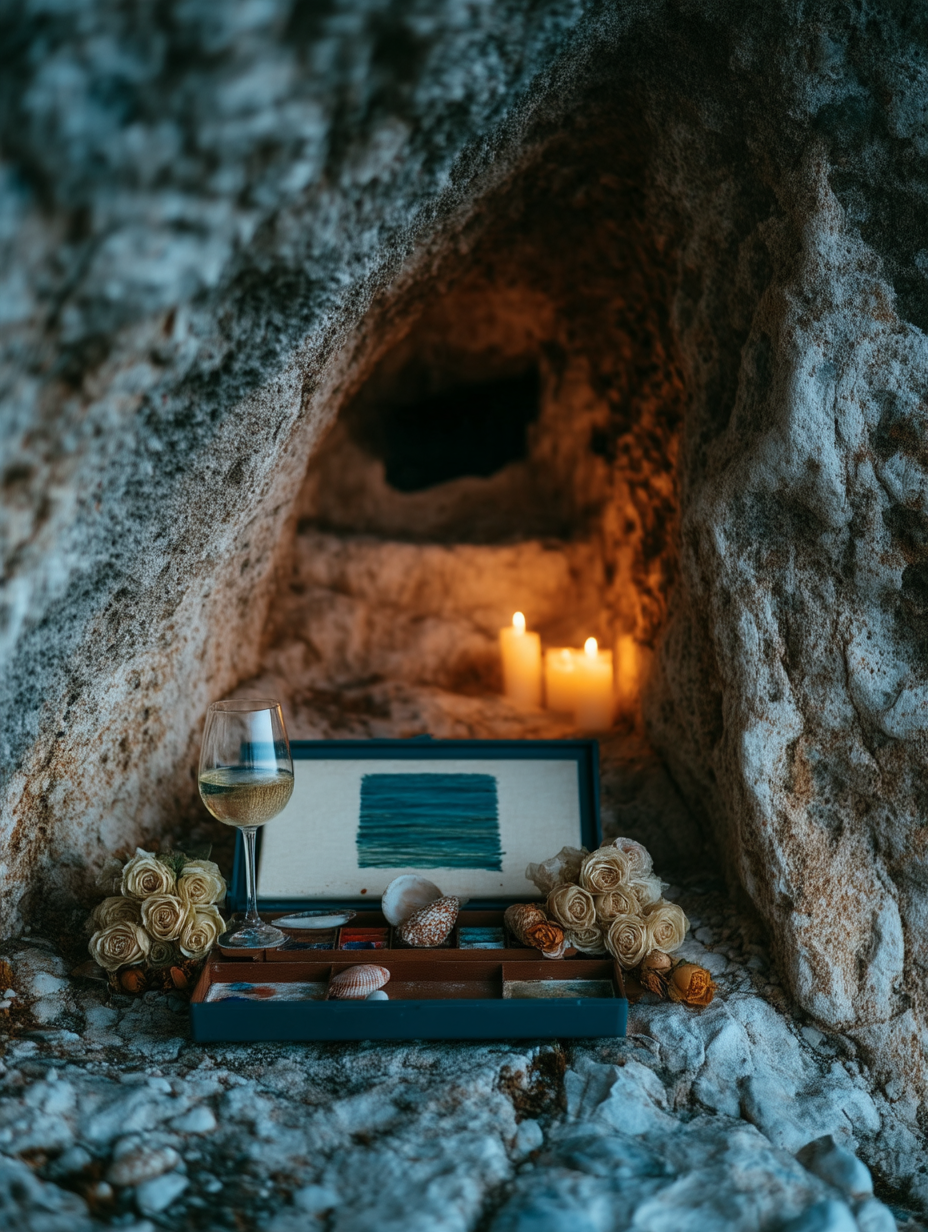
As a table for offerings Del and I put Olivia’s sketching box here. You can see on it a glass of dry white wine which is never empty, and a dark rose in a little glass jug. Olivia brought roses to the island. Around the gravestone are a multitude of shells, echinoderms and other “flowers of the sea”…
Olivia left her fortune to Delphine. So now a fisherman’s daughter has money enough to buy exactly such an island.
Stas Rybkin: A very beautiful, kind and sad story. However, the simultaneous and independent presence of Byung Min in your life and in Del’s seems to me at the very least an astonishing coincidence.
Oleg Batygin: Any truly large-scale coincidence looks fairly improbable. It looks that way, however, only if we consider it within a trivial system of probabilities.
That is to say, we see several events that have occurred which had very little chance of happening to any ordinary component of the system. But is the Hunter an ordinary component? By his very existence the Hunter affects the amount of uncertainty in the system. Which is to say that he governs the very probability that is lacking for this large-scale coincidence to look natural.
At a certain moment I became very deeply ashamed of my suspicions about Del. And at that same moment one simple thought literally pierced me. I had got used to regarding Byung Min negatively. But what had been the cause of it? The morning’s fright, brought on by my handler’s boorish tone, laid over a post-cannabinoid case of the jitters. Byung Min’s repellent appearance. The gangster tattoos on his fingers. That is all.
Not one of the reasons listed gives me any real grounds for considering Byung Min a bad man. What frightened me, as I have said, was not him. He simply looked at me and went away in silence. And then he went and granted my monstrously expensive wish. He fulfilled my childhood dream.
In essence Byung Min is my benefactor. Of course I did pay a certain price for the assistance he rendered. But by comparison with what Byung Min did for me that price is utterly negligible.
Byung Min’s repellent appearance, by all appearances, was not in the least the consequence of excess. Most likely he was suffering from some dreadful, progressive illness. And it is highly likely that the illness was somehow connected with his particular properties.
And if he really is a Hunter, he has to work with “dangerous liaisons”. And what is the easiest way to discover those dangerous liaisons? Why, to immerse oneself deeply in the international criminal community. Hence his tattoos.
Social prejudice too made me think badly of Byung Min. I am disposed by default to take a poor view of high-ranking managers. Yet I know perfectly well that among them, too, exceptionally vivid and noble people are to be found. My friend the “dark corporate angel”, for instance, whom I told you about yesterday.
When I became ashamed before Del of my suspicions, I revised my attitude to Byung Min as well. And at that point the “cannibal” hypothesis of our community’s origins stopped leading the field among my suppositions.
Obviously the figure of the Hunter grew out of my computer model. In reality we do not know who or what Byung Min is. But the Hunter is my invention, and I am free to give the Hunter a definition so generalized that it will extend to Byung Min as well.
In any system of high complexity there exist “non-standard components”. That is to say, elements upon which a special function has been laid. Byung Min is precisely such a “non-standard component”. And now imagine that there are many such “non-standard components” in the system. There are several orders of magnitude fewer of them than of ordinary components. But all the same there are not a few of them. It is highly likely that such components will coexist within some special “probability space”. Which is to say that chance will work for them differently than for the other components of the system.
There is a logic to this. Rare components of a system ought to possess greater invulnerability than common ones.
“Non-standard components” ought to differ strongly from one another and from everyone else. Each non-standard component performs its own special function. It is honed for it. And this determines its differences.
Stas Rybkin: Am I right in understanding that the “non-standard components” of the system include you and Delphine as well?
Oleg Batygin: Quite right. Delphine, and Olivia, and even my own insignificant self. All of us are “non-standard components” of the system of one kind or another.
And at that point I asked myself a question. Here I am, a “non-standard component”. And what “non-standard” thing do I feel? Do I myself sense this “non-standardness” of mine in any way at all? I like cannabis and programming a little more than everyone around me. I read more abstruse books than other people. My sexuality is fairly specific, though hardly out of the ordinary. And those are all my peculiarities.
I questioned Del. She too felt nothing special about herself. She had a developed “artistic self-identification”. Since childhood she had been used to imagining herself a princess of the sea. For many years she had been inventing and sketching a world of powerful underwater beings. But she was well aware that all this was simply an enormous and carefully elaborated fantasy.
The only thing that surprised Del about herself was her strange, paradoxical good luck.
And then it dawned on me. The only thing genuinely unusual about me, about Del and, quite probably, about Byung Min too, is not what we are, but what happens to us.
That is to say, from the position of the “non-standard component” itself, he is in no way different from the others. Byung Min was a powerful and most likely criminalized executive, given to vivid, paradoxical decisions. Possibly he was also given to a specific, desperate form of patronage. Possibly it was precisely within the framework of that kind of patronage that Del and I got what we got.
It is highly likely that it was his illness that made Byung Min a philanthropist. Such things happen. Powerful men who are dying sometimes hurry to do something beautiful before the end.
That is to say, possibly Byung Min was nothing extraordinary to himself. He did not feel himself to be either Olokun or a Hunter. Most likely he felt himself to be an ordinary very rich and very ill former gangster, seeking to put his money and his power to something possessing at least a minimum of meaning.
A “rare event” happened to me. And as a result I was, as it were, “sucked” into the probability space inhabited by “non-standard components”. And this mysterious “probabilistic overworld” turned out to be far more cramped than the large world in which several billion people live. So there is nothing surprising in the fact that I keep meeting the same faces all the time.
I grew used to the probability field characteristic of that space. I learned to act in the spirit of “non-standard components”. And in the end I became one of them. I began to change a certain part of the world quite radically. Which is to say that in a certain sense I became a continuation of Byung Min.
Stas Rybkin: If we consider all this within the framework of the African mystagogical interpretation, you have simply become kin to the gods.
Oleg Batygin: Exactly. I have indeed “become kin” to them. But my human nature has not become anything else because of it. A rare event drew me into an “overworldly” probabilistic fluctuation. And I now live in the field of a special “divine chance”, yet I have acquired no superpowers in the process. Except, perhaps, that I got a little money and some free time to carry out my engineering projects.
Remember I told you that my role in this whole song and dance is not at all significant. I am merely Olokun’s son-in-law. A good, loving, but still mortal husband, to whom the master of the Ocean consented to give his dearly beloved daughter.
Stas Rybkin: So everything that is happening is happening somewhere at the junction of the interests of ultra-modern corporate “angels” and “gods” and madly ancient African mystical entities…
Oleg Batygin: Exactly. And the most vivid, the most memorable of these personages is at once a corporate and a mystical figure. On the other hand, the “corporate hypothesis” and the “mystical interpretation” are no more than narratives telling us what is essentially the same story. Two cultural traditions generate two dissimilar explanatory patterns describing one and the same phenomenon.
“The Magnificent Seven” was created as a retelling of the plot of Kurosawa’s “Seven Samurai” in the space of the traditional western.
We have only one quantum mechanics. But of its interpretations there is a devil of a lot. And the African mystical narrative is, to my taste, not at all bad. It has been honed over centuries. It is easy to remember. And within its framework it is easy and convenient to reason.
I think that every FTB is an inhabitant of the aforesaid “overworldly probability space”. Usually he gets there by virtue of some particular, rare event. And it seems to me that it is fairly dangerous for an FTB to leave that space. The moment he finds himself back in the ordinary human world, all the troubles accumulated during the time spent in the “overworld” will descend on him at once. And that is one more reason for you not to sail away from the island tomorrow.
Stas Rybkin: But I am not an FTB.
Oleg Batygin: What makes you so sure?
Stas Rybkin: Hm… That is an unexpected question… I want terribly to become an FTB. And I do not want in the least to sail away from the island. However, if I do not return to Moscow by the promised date, I shall not merely lose a very large sum of money. I shall also let down people to whom I owe a great deal.
Oleg Batygin: I understand. Yet a known danger may with high probability turn out to be far less terrible than a danger lying hidden for the time being in the unknown. In any case, you still have time to think it over.
Stas Rybkin: Yes. Now the story has come together completely, in all its strangeness and in all its oceanic scale. All that remains is to extract the right moral from this fable.
Oleg Batygin: With the moral everything here is comparatively simple. We have built a civilization racing towards the fragility threshold. We have built this cosy and beautiful paradise settlement. And this evening a “Robinzon Party” awaits us.