Island Life
Stas Rybkin: It’s eight in the morning on my watch. We’ve gathered at the bar where we talked yesterday, about to set off on a tour of the settlement.
Oleg Batygin is already here. There he sits with a little bottle of soda. As you can see, there’s no label on this bottle. Because the label would make it easy to guess which country the island we’re on belongs to. Now I’ll go quiet for a while and let Oleg Batygin do the talking.
Oleg Batygin: Let’s start with the house where you spent last night. You’ve already had a chance to look it over in detail.
This is the oldest structure on the island. I built it literally with my own hands. Not alone, of course. Obviously, in its early version there weren’t any architectural flourishes in the tropical modernist style. We added those later.
Like many professional programmers today, I didn’t graduate from a relevant institution at all. I studied architecture. But over those years, my Soviet-trained instructors managed to instill in me a lasting aversion to any kind of construction.
Then I spent a few years working in Delhi and vacationing in Sri Lanka. There I saw the architectural work of Geoffrey Bawa and Minnette de Silva. Deeply struck by it, I started sketching things in a Moleskine. A kind of architectural postmodernism. Lots of quotation…
At first this house was a simple wooden house on stilts. Later I turned the space underneath the floor into this living room.
I started construction about a month after taking possession of the island. I brought in a couple of electric generators, a lot of gasoline for them, cement, carpentry tools, steel beams, and four workers to build the house. I myself lived in the grotto at the time — I’ll show it to you later — while the workers slept in tents.
I took part in the construction alongside the workers. There was no internet on the island back then, obviously. And honestly, I wanted a break from computer work myself for a while…
Now let’s go through that gate over there, between the bushes of blooming bougainvillea…
…………………
We’ve come out onto the only street in our settlement. There are just six houses on it. This is where the members of our community live. Everyone here is crazy about landscape design, which is why there are so many flowers around. Orchids, hibiscus, passionflowers, plumerias, bird-of-paradise, hydrangeas… lots of lilies in traditional ceramic bowls…
The houses are all different. We design a home for each family individually. There aren’t enough of us here to bother with standardization.
Our daily life here is your standard tropical arrangement. Everything’s set up very simply. Screens on the windows. Hammocks. Fans. We don’t use air conditioning. Our climate is maritime. It never really gets hot.
Let’s walk this street to the end. Here my wife laid out a rose garden. A kind of concentric miniature maze. The roses are set off nicely by ferns. Behind them is a tall English boxwood hedge. There’s a passage here. And beyond it is the recreation area. A pool and a park.
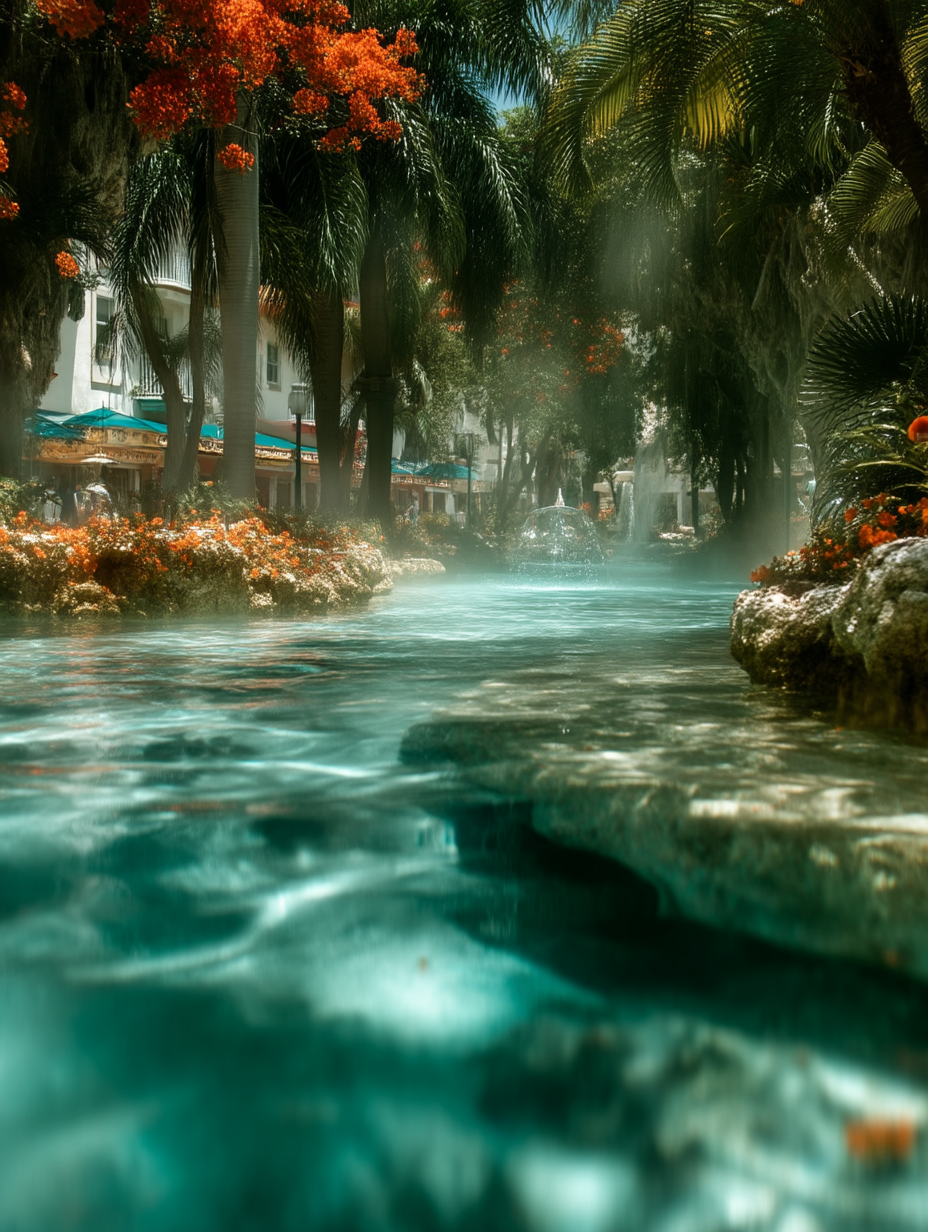
Stas Rybkin: The pool is very large and deep. It’s built like an artificial river — a ring of water around a central island. On the island stands a big, unusual fountain. In shape, the fountain resembles a mushroom-shaped coral.
There’s a pedal here. I press it, and the fountain starts running while the artificial river comes to life. A current appears. Past the pool is a small but exceptionally cozy garden. Paths of genuine rough-hewn stone. Whimsical benches carved from huge root masses of Tectona grandis — teak, that is.
The park amounts to an interesting dendrological collection. Personally, I can identify a lot of teak here, several varieties of plumeria. Those bright yellow patches over there are xylia. At the far end of the garden you see a dazzling red burst of Delonix regia. I adore that tree. They call it the brightest tree on Earth.
I’m very fond of the strategy game “Tropico.” In it you manage a tropical island. Among other things, you trade in the tropical timber growing on the island. The forest gradually runs out, and you have to replant it. The trees the Tropico foresters plant are either dazzling red delonix or bright yellow xylia. So the island, dark green at first, gradually turns into something like a red-and-yellow birthday cake.
Oleg Batygin doesn’t overdo it with either xylia or delonix, and that says a lot in favor of his taste. Or his landscape architect’s taste, maybe. Tell me, Oleg, did you build this garden yourself?
Oleg Batygin: No. The garden is my wife’s brainchild. She has a background in biology. And she’s passionate about painting. I think it was her landscaping work that set off the whole flower-growing boom in our community, too.
Stas Rybkin: It would be interesting to talk with your wife.
Oleg Batygin: You’ll certainly get to, this evening, at the upcoming party.
Stas Rybkin: Wonderful. Let me practice my identification dendrology a bit more. This tree here is unmistakably Red Sandalwood. Its wood is exceptionally valuable.
And this giant, moss-covered trunk with the flat, fence-like roots — that’s Ceiba pentandra, the kapok tree.
Oleg Batygin: Honestly, I’m surprised by your knowledge of tropical dendrology. If it’s not a secret, where does that come from?
Stas Rybkin: No secret at all. I studied to be an architect too, same as you. Just a landscape architect. Same as you, once I graduated from a Russian institution, landscape design struck me as repulsive. So I came up with a quiet but profitable home business for myself. I took up growing bonsai. I used tropical species for it. That’s when I learned a great deal about tropical flora.
My first YouTube channel was actually about bonsai. Over time my fascination with the tropics and with video reporting grew into what it is today.
Oleg Batygin: Very interesting. Let’s cut straight through the garden. Here, in the jasmine and duranta bushes, there’s a passage. More of a crawl-through, really. And beyond it is the school. We deliberately set it up so the walk to school would be a pleasure for the kids. They go through the rose garden, past the pool, and through the park. Then they duck into these fragrant bushes. We figure it gives them a bit of extra motivation for learning.
The school is quite small. But we don’t need a big one yet anyway.
Stas Rybkin: Are there children on the island?
Oleg Batygin: Right now we have four little ones here. Two of them are old enough for school, and we teach them right here. We’re hardly going to ferry them across the sea to school every day. My wife, Del, teaches at the school. She was born on one of the islands off the eastern coast of Africa. For certain reasons, I’d rather not say exactly which island.
Besides the children, some Black youths also study at the school. All of them are Del’s relatives. Many of them, before they came to the island, couldn’t even write in their native language. Now they have a good command of English, and those who want to can also study math, physics, and programming. I teach them a few lessons a week myself and find educational content online for them.
Stas Rybkin: Is Del short for Dolores, or maybe Delilah?
Oleg Batygin: Del is short for Delphine.
Besides me, there are only two white people living on the island. They’re old friends and partners of mine. Very passionate people, and excellent specialists.
Now, please look up and to the right, at the mountainside. You can see a roof there. Those are our workshops. We deliberately put them farther away. So as not to make noise. Obviously, on the island we only assemble prototypes of our concepts. Our actual production is on the mainland. It’s a small operation, but a quite profitable one nonetheless.
Stas Rybkin: Am I right in understanding that you manufacture some of your own inventions?
Oleg Batygin: These inventions are, of course, not only mine. I could never have handled them alone. Working with me are Robert, a chemist from Edinburgh, and Alexey, a physicist — a former Muscovite, like me. These two joined me back when there was still just one house on the island. In those days we were paying insane money for satellite internet…
Stas Rybkin: And may I ask what exactly you manufacture? Or is that a secret?
Oleg Batygin: Of course there’s no secret here. Back in the day, I called on my friends to solve the two main problems of island life. Electricity and connectivity. We solved them. And now we sell those solutions.
With electricity, we didn’t invent anything new. We simply gather up the latest developments in “green electricity” and build unique, integrated solutions for each individual isolated corner of the planet we’re commissioned to electrify.
We use every possible source of natural energy. Everything from tides, wind, and sun to processed leaf matter and swamp gas. Our approach is tailored to each case, and our solutions are expensive.
Even so, we have a queue of clients — not a long one, but a real one nonetheless. We’re not planning to expand our production capacity, since we don’t want to attract mass attention to ourselves. Besides, we live for the sake of life itself. And we have absolutely no wish to drown in a production grind.
With connectivity, things are a bit different. We came up with an original, exceptionally cheap and efficient way of transmitting a digital signal through water. Technically, our design is unique. But again, we didn’t invent anything new here either. We combined known technologies and arrived at a result that’s efficient and, to my taste, elegant.
We assemble and sell a certain number of these systems at our workshops on the mainland. They’re not too expensive. Even so, orders for them aren’t exactly plentiful. We recognize only one form of advertising — word of mouth. That is, we’re happy to let rumors about our system spread from mouth to mouth, so to speak, but we don’t run any other kind of advertising.
Now let’s cross that humpbacked wooden bridge over there. And along a very pretty path, through a pistachio grove, we’ll arrive at our vegetable garden.
…………………
Around us are the plantations. They’re quite picturesque. As you can see, we grow a great deal of different things — everything from yams, garden vegetables, and spices to cultivated cannabis. The fields are worked entirely by our community’s own hands. It’s not large, which is why there’s quite a lot of assorted electric farm machinery here. Mostly Japanese- and Korean-made equipment.
The soil here is excellent, there’s plenty of sun, and everything grows wonderfully well. The only serious agricultural problem here is insect pests and fungi. But my wife is quite deft at coming up with all sorts of purely biological ways to protect our gardens, and we hardly use any toxic chemicals at all.
Now let’s head over to the dock and the beach. It’s simply beautiful there. I’ll keep quiet, and you can film. And after that, we’ll head to the picturesque grotto, which is the sole “cultural heritage” site of our small, modest civilization.