What the Photographs Remember
I. The Vinegar and the Apple
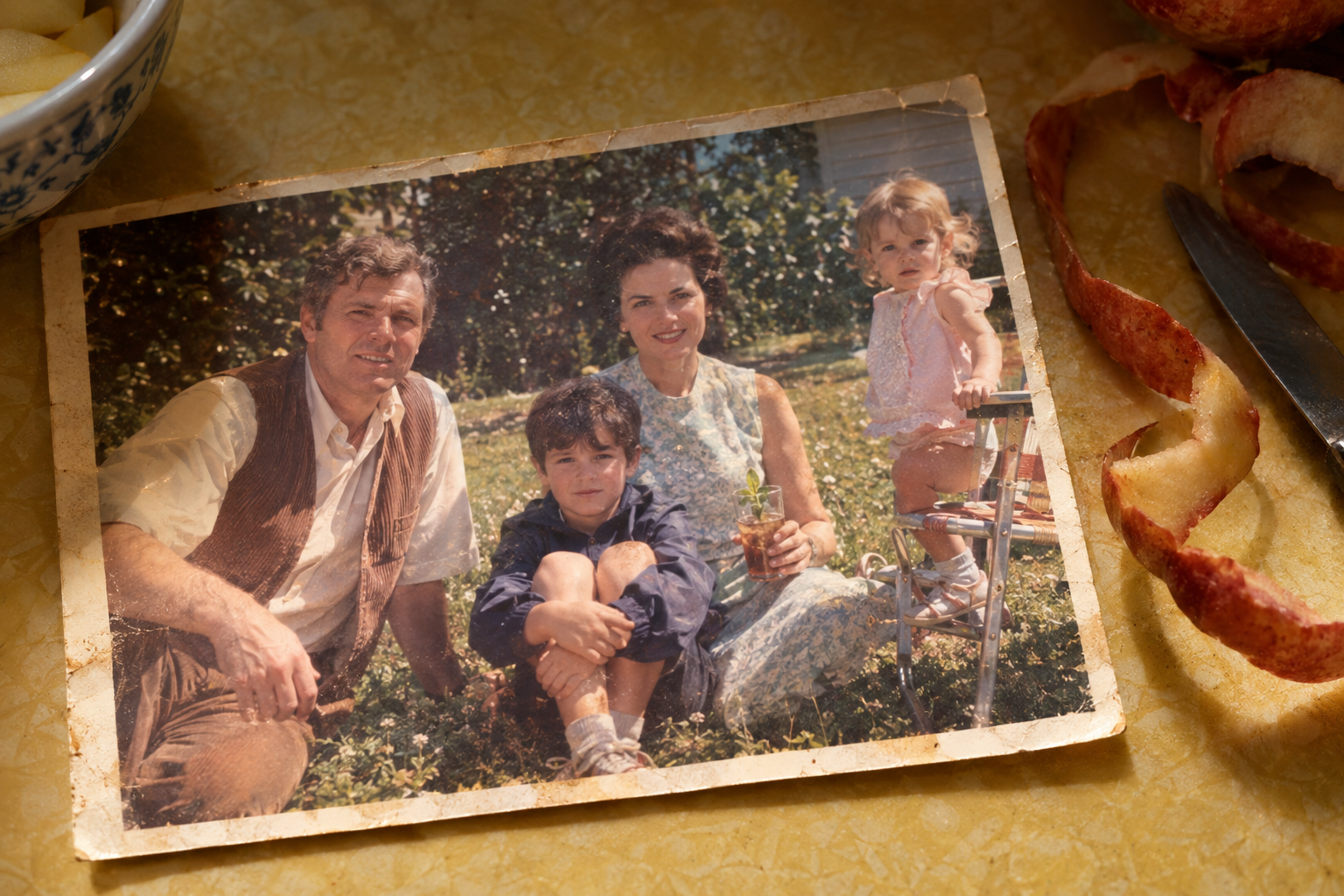
The attic smelled of dry joists, disintegrated cardboard, and the faint vinegar rot of degrading acetate. Beneath a stack of yellowing utility bills from the winter of 1982, I found a square Kodak print dated August 1978. It was an overexposed lawn portrait, the chemical colors shifting toward the magenta of boiled ham: my father in a corduroy vest, squinting against the late-afternoon glare; my mother holding a glass of iced tea with a sprig of mint floating among the cubes; my sister, barely two years old, balanced precariously on the canvas arm of a folding lawn chair; and between my parents, sitting on the dry clover with his knees drawn up to his chin, a slender boy of perhaps seven or eight with dark hair and sharp, pale collarbones.
I looked at the boy’s face for a long time. There was an unsettling symmetry between the line of his jaw and my own, but the eyes were darker, set deeper beneath a straight, unplucked brow.
I took the print down the narrow stairs to the kitchen, where my mother sat at the yellow Formica table peeling Cortland apples for a tart. The radio was playing a low, indistinct string quartet from the college station in town. She was seventy-two, her knuckles swollen with arthritis, but her hands moved with the mechanical efficiency of someone who had prepared forty years of autumn dinners in the same four yards of linoleum.
I set the photograph on the table beside the curl of red apple peel.
She glanced down, her paring knife never breaking its rhythm. She barely hesitated before tapping the boy’s chest with the flat of her thumb, leaving a faint crescent of apple juice on the glossy paper.
“That’s your brother,” she said. Her voice was light, completely unburdened, the way she might identify an old toaster or a neighbor’s collie that had died during the Carter administration.
The air went out of my chest in a quiet, uneven whistle. “What do you mean?”
“Julian,” she said, dropping a clean white crescent of apple into a bowl of salted water. “He had that little navy windbreaker he refused to take off, even in July. Your father finally had to cut the zipper out with wire cutters because he jammed the teeth with sand at the quarry.”
I stared at her. “Mom. I don’t have a brother.”
She stopped then, the knife resting against the curve of the fruit, and looked up at me with mild, puzzled amusement. “What on earth are you talking about, David? Of course you have a brother. He was sixteen months older than you.”
“I was an only child,” I said, the words sounding absurdly loud in the quiet kitchen. “Until Claire was born in eighty. I lived in the back bedroom. There was one twin bed. There was one desk.”
“You shared the room until seventy-nine,” she said simply, as if correcting a minor error in a checkbook. “Then we moved him across the hall into what became your father’s drafting room. Don’t be dramatic. Hand me the cinnamon from the second shelf.”
“Where did he go?”
She blinked, her pale blue eyes clouding with a faint, momentary irritation—not at the question, but at my slowness. “He went away after that winter. You know that perfectly well.”
“Away where?”
“To school,” she said, her voice dropping into that smooth, impenetrable register she used when my father’s illness had become too difficult to discuss in public. “He needed different air. The doctor from Albany said the valley damp wasn’t good for his chest.”
“Did he die?”
“David, please,” she said, picking up another apple. “Your father’s service was three weeks ago. I am not in the mood for parlor games. If you aren’t going to help with the basement boxes, at least go back upstairs and clear the cedar chest. The Salvation Army truck is coming on Thursday.”
She turned back to her work. Her pulse did not jump in her throat; her hands did not tremble. The apple skin came away in a single, unbroken ribbon, curling onto the oilcloth in a long red coil.
I stood there for three minutes, waiting for the joke to break, for her to smile and explain the trick, for some crack to appear in the smooth porcelain of her certainty. Nothing came. There was only the rhythmic snip-snip of the paring knife and the faint, dry scrape of her slippers against the floorboards.
II. The Inventory
I did not go to the cedar chest. I went to my father’s study on the ground floor—the small, windowless room behind the pantry where he had kept his tax ledgers, his surveyor’s transits, and his lockboxes.
My father had been a municipal draftsman for the county water authority. He was a man who did not believe in discarding paper; he believed in classification. Every receipt for every gallon of heating oil purchased between 1964 and 2002 was filed chronologically in green steel cabinets that smelled of dry graphite and machine oil.
I started with the bottom drawer of the olive-drab cabinet beneath the drafting table.
Within twenty minutes, the house began surrendering Julian from every corner, not as a phantom or a rumor, but as an administrative fact.
In an accordion file labeled Vance – Medical / Dental, I found two yellow immunization cards issued by the Dutchess County Board of Health. The first was mine: David Thomas Vance, b. Oct 3, 1973. The second was clipped to the back with a rusted paperclip: Julian Edward Vance, b. May 14, 1971. Every entry was recorded in the same spidery, blue-black fountain pen: DTP at six months, oral polio vaccine in the spring of ’72, a smallpox scarification recorded in July ’74 at the clinic in Red Hook.
I sat back on my heels, the cold concrete of the floor pressing through my trousers.
I went to the dining room sideboard. In the lower right drawer, tucked behind the heavy linen tablecloths we only used for Thanksgiving, was a gray flannel roll containing the family silver. Inside were five sterling napkin rings engraved by a jeweler in Poughkeepsie. I unrolled them on the mahogany table: A.V. for Arthur; E.V. for Eleanor; C.V. for Claire; D.V. for David. And a fifth ring, slightly smaller, bruised around the rim where child’s teeth had worried the silver: J.V.
In the hall closet, behind the vacuum cleaner hoses and a box of defunct holiday bulbs, I found a pair of leather track shoes, size 4, with rusted steel spikes. Tucked inside the left shoe was a cardboard ribbon from the St. Jude’s Parish Invitational, dated May 1979: Third Place – 400 Meter Junior Dash – Julian Vance.
I carried the ribbon to the window. The ribbon was frayed at the hem. The ink was faded, but the handwriting was Sister Mary Catherine’s; she had been my third-grade teacher four years later. I remembered her square, chalk-stained thumbs with absolute clarity. I remembered her classroom with the terrarium in the corner and the statue of the Infant of Prague on the radiator.
I did not remember Julian running in the lane beside me.
I went to my father’s steel fire-safe in the closet. The combination had been my mother’s birthday, reversed. Inside were the family deeds, the insurance policies, the automobile titles, and a manila envelope containing our birth certificates.
I pulled them out.
There was my father’s certificate from 1941, printed on heavy vellum. There was my mother’s from 1946. There was Claire’s, modern and blue-bordered, from the Northern Dutchess Hospital in Rhinebeck.
And there was mine.
There was no certificate for Julian.
Instead, tucked into the pocket of the envelope where his paper should have been, was a single, blank Application for Delayed Registration of Birth from the New York State Department of Health. The lines for Child’s Name, Date of Birth, and Attending Physician were completely empty. But at the bottom of the page, pressed into the blank, unwritten cardstock, was the circular, raised seal of the County Clerk—an embossed ring of paper teeth biting into nothing, certifying an absence that had already been officially processed.
III. The Loupe
I took the shoe box of loose photographs from the attic and brought it to my father’s drafting desk. I turned on the green-shaded architect’s lamp, pulled his ten-power Bausch & Lomb brass loupe from its velvet case, and began sorting the prints by year.
There were nearly two hundred photographs spanning the decade between 1972 and 1982: Instamatics, square Kodacolor prints with the white borders, 35mm slides in cardboard sleeves, and black-and-white contact sheets my father had developed himself in the cellar darkroom.
Julian was in forty-six of them.
Under the loupe, the domestic normalcy of the images dissolved into something that made the skin along my forearms tighten.
In every single photograph where Julian appeared, the composition suffered from a strange, off-center tension. In a picture from June 1976—a picnic at the reservoir—my mother and father were laughing at the camera, my father holding up a half-eaten sandwich like a trophy. Julian was sitting on the corner of the wool blanket. While the rest of the family looked directly into the lens, Julian’s head was turned at a sharp, forty-five-degree angle. His face was in profile, his pale, unblinking eyes fixed directly upon me, where I sat three feet away in the grass, attempting to pull a dandelion apart.
I moved to the next print: July 1977, behind the garage. My father had just painted the trim white. Julian stood on the second rung of the wooden stepladder. He was not looking at the camera. He was looking down at me, where I stood clutching the corner of the garage wall.
I pressed the loupe against the paper until the silver grain separated into clusters of dark dots.
My own face in these photographs was wrong.
I had always remembered myself as a cheerful, slightly vacant child—the sort of boy who spent three hours watching ants cross a gravel driveway. But in these prints, under the magnification of the lens, my small face was drawn into expressions of severe, exhausting vigilance. In the 1977 garage picture, my lips were pressed together into a thin, white scar, and my fingers were hooked into the waistband of my shorts so tightly that the denim was bunched into knots. In an August 1978 photograph on the porch, my hands were clamped around my own thin wrists, my shoulders raised to my ears, my chin tucked toward my collarbone in an attitude of rigid resistance.
He was always looking at me. I was always looking away from him, staring into the lens of my father’s camera with the wild, pleading gaze of a hostage trying to signal a passerby through a window without moving his lips.
Then I reached the bottom of the tin and found the oldest album: a small, black paper ledger from the winter of 1975, tied with a rotten silk cord.
I opened it to the first page.
It was an 8x10 black-and-white print of the house in the middle of the great blizzard of January 1976. The snow was up to the sills of the kitchen windows. In the center of the frame, standing on the shoveled flagstone path, was my father, his wool cap pulled down over his ears, holding Julian on his shoulders. Julian was laughing, his mittens pressed against my father’s temples, his mouth open in an ecstasy of childhood delight. My mother stood beside them, her arm hooked through my father’s elbow, her face turned up toward the boy with a look of pure, unhesitating adoration.
It was a perfect family portrait. It was complete.
I slid the loupe over the edges of the frame, across the shoveled snowbanks, across the frozen hydrangeas, to the corner of the wrap-around porch.
Standing behind the hemlock bushes, half-obscured by the drift that had banked against the storm door, was a small boy. He was wearing an oversized coat that did not fit him, his hands shoved deep into his pockets to keep from freezing. His face was pressed close to the glass of the porch window, his breath leaving a small, pale circle of frost on the pane.
I adjusted the focus of the loupe until the grain resolved.
The boy standing outside in the snow, watching the family laugh on the cleared path, was me.
I sat there in the cold light of the desk lamp, the brass barrel of the loupe growing warm against my palm. As I watched the print, something happened in the paper. It was not a trick of the light. A small dark smudge at the corner of the porch—a knot in the pine siding just behind the small boy’s head—seemed to soften, the grain drifting like silt in a stirred bucket of water, before settling into the crisp, sharp line of a second coat hanging from a peg that had not been there thirty seconds before.
The photograph was not recording the past. It was adjusting its margins to accommodate what had just been named in the kitchen.
IV. The Sister
My sister Claire arrived from the city at six that evening, driving her battered Honda through the autumn twilight. She was twenty-four, an illustrator for a textile firm in Brooklyn, with our father’s long, bony nose and an impatient, modern energy that usually made the old house feel like a museum she was visiting out of filial duty.
She dropped her canvas bag in the hall and kissed my cheek. “How is she?”
“She’s making a tart,” I said. “She’s fine.”
We sat on the back steps with two bottles of beer while the dusk turned the lawn from amber to slate gray. The crickets were thin and slow in the cold weeds by the fence.
“Claire,” I said, keeping my eyes on the line of hemlocks at the property line. “Do you remember the boy in the room across from mine?”
She took a sip of her beer, her throat clicking softly. “Julian?”
The name came out of her mouth without a stutter, without hesitation, without the slightest inflection of mystery.
“What do you remember about him?” I asked.
She laughed, a short, dry puff of breath. “Not much. I was only three when he went to the school in Vermont. But I remember that green sweater he had with the leather buttons. And that thing he used to do with his thumb—cracking the joint over and over when he was reading. It drove Dad crazy.”
I turned my head to look at her in the dim light. “Claire. I had a green sweater with leather buttons. Grandma knit it for me for Christmas in eighty-one. And I crack my thumb when I’m reading. Dad used to slap my hand away from my mouth at the breakfast table.”
She frowned, her beer bottle halfway to her mouth. She looked at me, her brow furrowing in genuine, gentle confusion. “Did you? No, David. You had the blue one with the reindeer. Julian had the green one. He used to sit on the radiator in the hall and read those old naval histories.”
“I read the naval histories,” I said, my voice dropping into a flat, hard monotone. “I got them from the library in Rhinebeck with my own card. I still have the one on Jutland on my shelf in Boston.”
“Well, maybe you got them because he liked them,” she said, her tone growing slightly defensive, the way younger siblings become when their ownership of a childhood memory is questioned. “I don’t know why you’re being so weird about it. He was the oldest. You always did what he did.”
“He wasn’t there, Claire.”
She set her bottle down on the wood step with a sharp clink. “What is wrong with you today? Mom said you were acting strange on the phone. First Dad dies, and now you’re pretending Julian didn’t exist?”
“Show me his room,” I said.
She stood up, annoyed, and walked back into the house. I followed her up the stairs to the second floor. She walked past my old bedroom—the one with the single window overlooking the garage—and stopped at the door to the small room at the end of the hall.
My father had used it for twenty years as his drafting office. It contained his flat-files, his rolls of tracing paper, and a drafting board covered in green vinyl.
Claire reached out and opened the door.
“Look,” she said.
I looked.
The drafting table was there, but behind it, occupying the alcove where my father had kept his reference encyclopedias, was a narrow, painted wooden bed frame. On the mattress was a folded Hudson’s Bay blanket with red and green stripes. On the bedside table sat a small glass dish containing three rusted paperclips, a lead soldier missing its head, and a half-empty tin of zinc ointment with the label peeled away.
The room smelled of cedar and cold iron.
“He slept there,” Claire said, pointing at the bed with a certainty so pure, so total, that for a fraction of a second my own memory seemed to tilt beneath me like a dropped tray. “Dad never took the bed down. He just built the desk around it because he couldn’t bear to move his things after he got sick.”
I walked over to the bed. I touched the wool of the blanket. It was cold and slightly stiff with age.
I had spent two days in this room in July, helping my father sort his blueprints. The alcove had been filled with four-drawer steel filing cabinets containing the water main maps for the entire township of Clinton. I had personally unscrewed the drawer pulls so we could haul the cabinets down to the truck.
The steel cabinets were gone. The floorboards where they had stood were covered in an even, undisturbed layer of gray dust, and in that dust were the round, deep indentations of four turned wooden bedposts that had clearly not moved in thirty years.
V. The Vault
At two in the morning, while my mother and Claire slept in their rooms down the hall, I went down to the cellar with a pry bar and a flashlight.
Behind the oil burner, where the fieldstone foundation of the 1890 farmhouse joined the poured concrete of the cistern, my father had set a heavy steel document box into the masonry. The hasp was secured with a brass padlock. I forced the flat of the bar behind the staple until the dry mortar gave way and the screws pulled free with a sound like snapping wire.
Inside were no surveyor’s maps.
There was a bundle of surveyor’s field-notebooks tied with butcher’s twine, a dozen yellowed carbon receipts from a pharmacy in Kingston that had closed thirty years ago, and a pasteboard accordion folder labeled only with a year: 1979.
I sat on an overturned wooden crate beneath the bare bulb and opened the folder.
The pages were all in my father’s hand—not his loose cursive, but the rigid, uppercase print he used on municipal blueprints, set down with a 0.5mm technical pen on blue grid paper.
There were no institutional headings, no letterhead. Only dated entries:
Oct 4, 1979. David’s temperature 102. Woke at 3 a.m. crying that the tide was coming into the kitchen. He did not recognize Eleanor when she brought the cloth. Called her ‘the woman from the pier.’ Found three inches of fine white salt sand in the heat register behind the radio. There has never been salt sand in this township.
Oct 12, 1979. Eleanor found two additional place settings in the sideboard that she does not remember buying: a blue willow plate and a silver egg cup. When asked, Julian said they belonged to ‘the other kitchen.’ David’s nose bled for forty minutes after breakfast. His pulse is forty-two. He cannot hold a fork.
Oct 21, 1979. A second winter coat was on the hall peg this morning. Heavy tweed, child’s size 6. When Eleanor brushed against it, she began to weep and could not recall her sister’s name. When I carried the coat down to burn in the furnace, Julian was standing at the top of the cellar stairs watching me. He asked if David was getting smaller.
Nov 6, 1979. The bloodwork shows nothing. It is not an infection. As long as they sleep in the same corridor, David’s mind will continue to graft onto what Julian remembers. The house cannot support two versions of the boy. David’s heart will fail before December.
Nov 18, 1979. The arrangement in Pittsfield is settled. Eleanor will take the draught on Tuesday evening. I will take the second dose with coffee on Wednesday. The chemist assures me the associations will clear within forty-eight hours. He would not promise they would stay clear.
Nov 25, 1979. Drove J. to the coast this morning. He did not cry in the car. When we stopped at the bridge, he asked if David would still have the scar on his thumb. I told him David would have everything.
At the back of the folder was a custodial passbook from Westerly, Rhode Island, and a slip showing monthly cash transfers to a post office box in Point Judith. The last deposit had been stamped four days before my father’s stroke.
Clipped to the passbook with an oxidized hairpin was a single square of yellow drafting paper, folded twice. On it, in my father’s pencil, heavily underlined:
Do not look for the cottage by the salt pond. If you bring him into your mind, you give him back the room.
VI. The Spit
I left the house before dawn, while the lawn was still white with frost. I did not leave a note for my mother or Claire. I drove east on Route 44, across the Hudson, through the stony hills of Connecticut, toward the coast.
The address was not a hospital or a nursing home. It was a weathered cedar-shingle cottage on the edge of a gravel spit between a salt pond and the open Atlantic, three miles south of the lighthouse at Point Judith.
The wind off the water was sharp with the smell of dead kelp and diesel exhaust from the trawlers heading out toward Block Island.
I parked the car in the crushed-shell driveway. The house was tiny, its windows gray with dried sea salt, its chimney made of rough fieldstone. There were no cars in the yard, no telephone lines running to the eaves, no television aerial on the roof.
I walked up the three wooden steps to the porch. The storm door was unlatched, clicking rhythmically against the jamb in the gusting wind.
I knocked.
There was no sound from inside except for the low, dry rattle of a woodstove draft.
I turned the brass knob and pushed the door open.
The room was clean, cold, and bare. The walls were unpainted pine; the floor was bare fir planks scrubbed until the grain stood up in pale ridges. There were no photographs on the mantel, no calendar on the wall, no books on the table by the window.
A man was sitting in a wooden rocker by the cast-iron stove, his hands resting flat on his knees.
He was fifty-three years old, thin, with gray hair cut short to the scalp. He wore a faded navy wool sweater with bone buttons, brown canvas trousers, and wool socks without shoes. His collarbones were sharp beneath the wool, his jawline matching the line of my own.
He did not look up when the door opened. He kept his eyes on the iron seam of the stove, where orange light flickered through the draft wheel.
“The door doesn’t latch,” he said.
His voice was thin, rough from disuse, but its timbre was familiar—the voice I heard in my own throat when I read silently in an empty room.
I stepped inside and pushed the door shut against the wind. “Julian?”
He turned his head slowly.
His eyes were pale and rheumy, shifting from my jacket to my hands with a slow, uncertain squint.
“You grew,” he said.
I stood by the threshold, the smell of woodsmoke and sea salt thick between us. “You remember me?”
Julian looked down at his left hand. He rubbed the base of his thumb, where a three-cornered white scar sat in the skin—the exact scar I had carried on my own thumb since childhood.
“Father said you were working in town,” he said. He looked toward the salt-filmed window. “I keep thinking the dog is in the kitchen. But we had the terrier in Rhinebeck, and we had the black hound in Maine. I don’t know which one we buried.”
“There was no house in Maine,” I said.
He did not argue. He turned his hands over in his lap, palms up, the skin dry and yellowed around the knuckles. “Sometimes I remember dying when I was four. In a hospital with white tiles. And then I remember the ice on the pond, and Father pulling my coat out with a boat hook.” He looked up at me, his brow creased in mild, distant confusion. “My head doesn’t quiet down.”
“Why didn’t you leave?” I asked.
He looked at the bare pine walls. “When people come by, things get loose. The mailman stopped to ask about the storm last winter, and then he started crying because he thought his sister drowned forty years ago. Father told me to stay by the stove. He said if I don’t think about the room across the hall, the water stays outside.”
He leaned forward slightly, his gaze drifting to my coat pocket.
“You brought the paper,” he said.
I reached into my pocket and pulled out the square Kodak print from 1978.
I stepped to the window and held the photograph in the cold, gray light coming off the water.
The print had shifted again.
My father was still there in his corduroy vest. My mother was still holding her glass of tea. Claire was still balanced on the arm of the lawn chair.
Julian was still sitting in the dry clover between them.
Except now, his chin was not turned toward the edge of the frame. His face was lifted squarely toward the lens of my father’s camera, his eyes wide, clear, and staring directly out of the paper with a flat, undisturbed calm.
And in the space beside him on the lawn, where the small boy with the clamped wrists and the drawn, watchful mouth had stood for forty years, there was only an empty expanse of crabgrass, the long shadow of the porch hemlock, and my sister’s red plastic bucket lying on its side in the weeds.
I looked from the print back to the rocker.
Julian was no longer looking at me. He had turned back to the cast-iron stove, his hands resting motionless on his knees, watching the orange draft wheel flicker against the dark hearth.
He did not speak as I opened the door. The brass latch clicked behind me, and the salt wind off the spit took the sound away into the surf.
### VII. The Apple
I drove back to High Falls in the late afternoon. The sky was the color of lead, heavy with the promise of more snow before nightfall.
The house was warm when I opened the back door. The smell of baked apples, cinnamon, and burnt sugar filled the kitchen, thick and domestic and sweet.
My mother was standing at the stove, using an old tea towel to pull the cast-iron skillet from the oven. Her movements were smooth, steady, and unhurried.
She set the pie on the trivet on the yellow Formica table.
She looked up at me as I came in, her pale blue eyes clear and unclouded by grief, by memory, or by doubt.
“You were gone a long time, David,” she said, her voice light and level. “Did you bring the cedar hangers down from the attic?”
I took off my coat and hung it on the peg behind the door. I looked at the table.
There were three plates set on the oilcloth: one for her, one for Claire, and one for me. Beside each plate was a polished silver napkin ring.
Four of them.
A.V., E.V., C.V., D.V.
The fifth ring was gone. The sideboard drawer behind her was closed and silent.
“I forgot the hangers, Mom,” I said.
She sighed, a small, gentle sound of maternal resignation, and picked up the pie server. “Well, never mind. You always were the absent-minded one. Your brother would have had the whole attic cleared by noon.”
She cut a neat, perfect triangle of pie and slid it onto my plate.
“Sit down,” she said, her voice soft, practical, and entirely without fear. “Eat it before the butter goes cold.”