Chapter 8: The Sound of Real Work
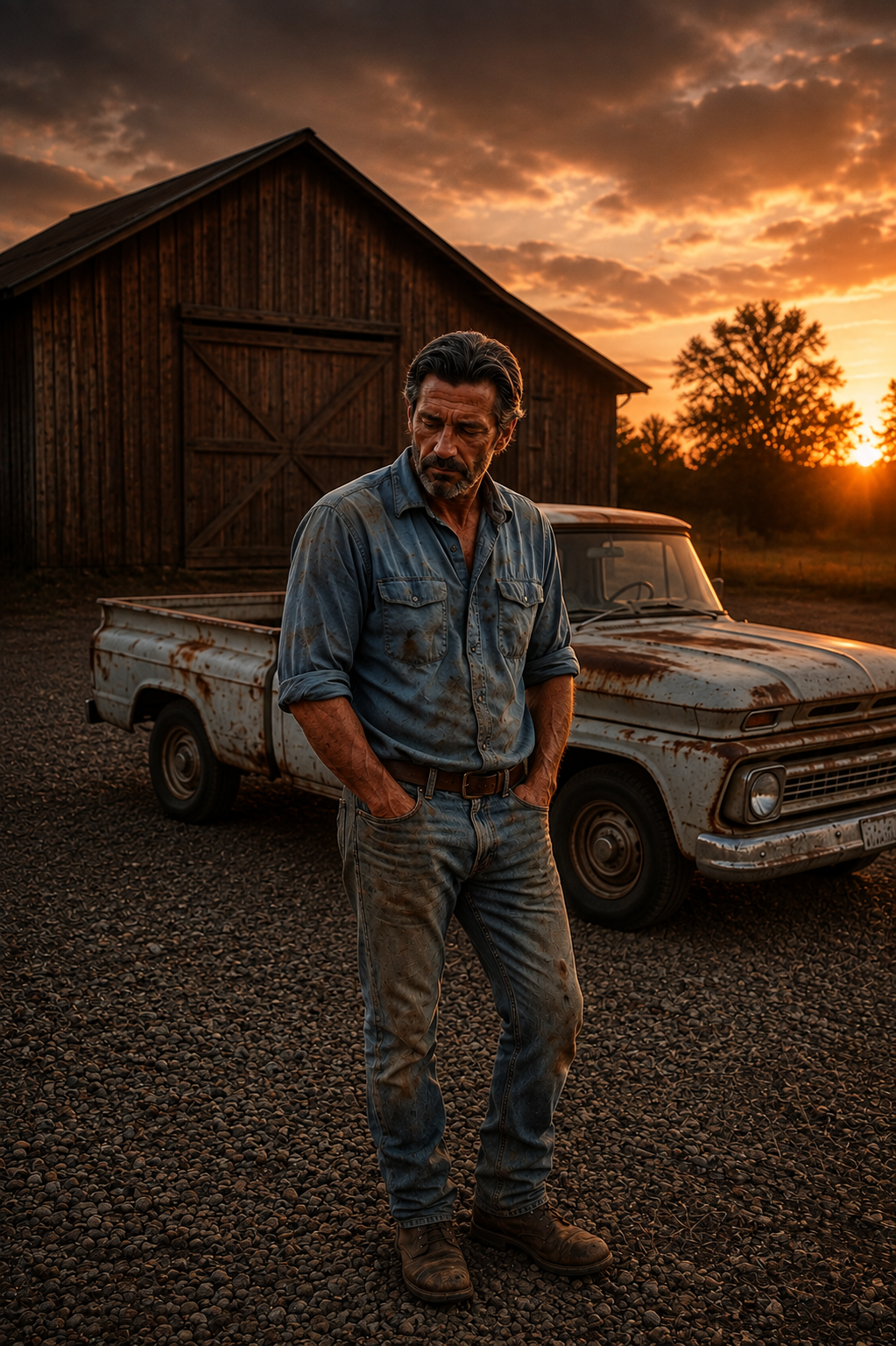
Frank sat low in the cane-bottom chair on the front porch, his elbows resting on his thighs and his eyes locked on the yard, brooding over the quiet trap his life had become. The pristine amber hue of the new cedar shed didn’t feel like a blessing; it felt like an eviction notice for his own sweat and purpose.
The distant, rhythmic drone of the Massey-Ferguson drifted down from the Gentry rise—a steady, mechanical hum punctuated by the whine of the bush-hog blades cutting through briars. That was Darrell up there. Frank’s boy. Working the way Frank had taught him—leaning into the machine, letting the weight of the tractor do the heavy lifting, but keeping the throttle steady so the blades didn’t bog down in the thick growth. It was honest work. Real work. The kind that left a boy choked with dust and his shirt soaked through by mid-afternoon.
Frank listened to that sound like a man clinging to a lifeline.
The screen door creaked open behind him, and Martha stepped out onto the porch, a chipped ceramic mug in her hand. She didn’t say anything. She just set the coffee down on the flat arm of his chair and stood there for a moment, her hand resting lightly on his shoulder.
“You been out here an hour,” she said quietly.
“I know.”
“You want to come inside?”
“Not yet.”
Martha’s hand squeezed his shoulder once, then let go. She didn’t push. She never did. She just stood there beside him, her eyes following his gaze out toward the shed. She saw what he saw. She felt what he felt.
He always kept his tractors in there, but now, the dark interior held something completely alien. Two factory-fresh tractors sat inside that new barn, their paint immaculate, their metal unmarred by a single day of real labor. They looked like they belonged on a showroom floor, not a working farm.
“They’re doing good work over there,” Martha said after a long silence, nodding toward the distant sound of the bush-hog. “You taught them right.”
Frank’s jaw tightened. “Yeah.”
“That’s yours, Frank. That sound. That’s what you built.”
He didn’t answer. He just picked up the coffee and took a long, slow sip, letting the heat settle into his chest. The mug was warm in his hands. The coffee tasted like Martha’s kitchen—strong, bitter, real. It was one of the few things left in his life that still felt like it belonged to him.
Martha lingered a moment longer, then turned and went back inside, the screen door closing softly behind her. Frank sat alone again, listening to the bush-hog, watching the shed, trying to hold onto the feeling that he was still the man who ran this place.
But the shed gleamed in the afternoon light, its fresh cedar planks glowing like honey.
Frank had asked for none of it. And that was the problem.
He took another sip of coffee and stared at the building, his mind turning over the same questions he’d been chewing on since dawn. What did it want? What was it trying to prove? And why the hell did it think he needed saving?
The sound of an engine sputtering broke through his thoughts—a rough, gasping cough that grew louder as it came up the gravel road. Frank looked up to see Lucas Baines’s old Chevy C10 limping over the crest of the hill, the engine misfiring and choking on whatever vapor was left in the fuel line. The truck gave one last hollow cough, rolled past the house, and coasted to a dead stop right on the new concrete apron of the equipment shed.
Frank pushed himself up from the chair, pausing a second to let his joints settle, then walked down the porch steps into the gravel. His boots crunched against the stones, and the sound felt good—solid, real, earned.
Lucas threw the truck door open and stepped out, his ball cap pushed back on his head, his eyes already darting from the new cedar planks of the shed down to the gravel beneath him. He looked like a man trying to read a map that had been rewritten since breakfast.
“Frank,” Lucas said, shaking his head as he pointed a thumb at the building. “What’d you do, rob a bank in town or find a gold mine under the orchard? I was just down the draw yesterday and this old building looked like it was ready to slide into the clay.”
Frank stepped up to the driver’s side fender, his eyes dropping to the space beneath the engine block. Right there, before the dust could even settle, a thick, dark drop of old engine oil dripped from the Chevy’s oil pan, landing right on the spotless, white concrete apron of the shed floor.
Frank watched the black spot spread across the pristine cement. A quiet, dark spark of satisfaction hit his chest, and his mouth twitched into a small, grim smile. It was an imperfection. A real, messy, human blemish on a yard that had been scrubbed of its history by something that didn’t belong to the world of hours and sweat. It proved the dirt could still be dirt.
Lucas noticed it too. He looked down at the oil spot, then back up at Frank, his expression shifting from amazement to something closer to unease.
“Hell, Frank, I’m sorry,” Lucas said, gesturing at the stain. “I didn’t mean to mess up your new concrete. That oil pan’s been weeping for a month, but I didn’t think it’d—“
“Don’t worry about it,” Frank said, his voice flat but not unkind. He kept his eyes on the black spot, watching it soak into the white surface. “It’s fine.”
Lucas frowned, clearly not convinced. “You sure? I mean, this looks brand new. I can come back with some degreaser if you want, try to—“
“Leave it,” Frank said, a little sharper this time. Then he softened, realizing how it sounded. “I mean it, Lucas. It’s fine. Concrete’s supposed to get dirty. That’s what it’s for.”
Lucas studied him for a moment, his eyes narrowing slightly, like he was trying to read something in Frank’s face that wasn’t being said aloud. Then he looked back up at the fresh timbers.
“Hired one of them Mennonite barn-building teams,” Frank said, his voice flat, throwing the lie out there like a shield. “They showed up in the middle of the night with a couple of flatbeds of cedar. Done before the sun came up.”
Lucas let out a low whistle, his eyes tracking the perfect seams of the wood. “Well, that explains the speed, I reckon.” He stopped, a look of sudden understanding crossing his face as he chuckled and rubbed the back of his neck. “Hell, that’s cause they don’t drive trucks. They use horses and wagons. No wonder I didn’t hear a thing hauling up the gravel road last night, and I usually catch everything moving in this hollow.”
He kicked at a loose stone with the toe of his boot, his tone shifting from amusement to something a little quieter, more protective.
“Still, you know how it’s gonna be down at the co-op,” Lucas said. “The minute Miller or Wilson drives up this road and spots this place, they’re gonna be running their mouths to everybody about how you must’ve taken out a massive loan to pull off a stunt like this. You’re gonna have half the county driving up here just to gawk. People don’t like seeing a man get ahead that fast without dust on his brow, Frank. You know how they are.”
Frank’s jaw tightened. “I didn’t ask for it.”
“I know,” Lucas said softly, studying his friend’s stiff posture. He didn’t push. He could see the heavy misery in Frank’s eyes, and as an old friend, he knew exactly when to let a topic drop. “Well… whoever they are, they do hellacious work. Even if it don’t quite look like you.”
The silence settled back over them, heavier this time. The bush-hog droned on in the distance, and Frank felt the weight of it pressing down on his chest—the sound of his boy doing real work while Frank stood here in a yard that had been stolen from him, piece by piece, by something he couldn’t see and couldn’t fight.
“So what’s wrong with the Chevy?” Frank asked, his voice rough.
Lucas shrugged, looking down at the truck with a frustrated sigh. “Don’t rightly know. It just started spitting and coughing a mile back and finally quit breathing altogether. Could be a clogged fuel line, bad fuel pump… not sure. But I need to get into town to the Western Auto, and then back out to the co-op to pick up some salt blocks for the cows before the rain hits. Still gotta check on my sister’s fence line before dark, too, so this breakdown has me in a real bind.”
Frank looked at the dead truck, then back toward the driveway where his own Dodge sat. For the first time all day, the heavy static in his head felt a little lighter. He couldn’t fix his own tractors anymore without the entity turning them into factory-fresh showroom pieces, but he could still do a neighbor a turn.
“Don’t worry about being stranded, Lucas,” Frank said, nodding toward the driveway. “Take my Dodge. The keys are in the ignition. Go run your errands, get your salt blocks, tend to your sister. I’ll stay here with the Chevy until you get back.”
Lucas’s eyes widened. “Frank, I can’t just—“
“You can,” Frank said firmly. “And you will. I got nothing but time today, and I’d rather be useful than sitting on my ass staring at a yard I don’t recognize.”
Lucas hesitated, clearly torn between gratitude and the instinct not to impose. Then he nodded slowly, his shoulders relaxing.
“Alright,” Lucas said. “But I owe you for this, Frank. I mean it.”
Frank shook his head. “You don’t owe me a damn thing. Just bring the truck back in one piece.”
Lucas grinned, the tension breaking slightly. “Deal.”
He walked over to the Dodge, climbed in, and turned the key. The engine fired up with a smooth, confident rumble, settling instantly into a steady, flawless idle.
Lucas let out a low chuckle, shaking his head as he leaned his elbow out the open window. “I swear, Frank, this is the only damn truck in the entire county that starts on the first try without a fight. You got a magic touch with this old Dodge.”
Frank didn’t answer. He looked at his own truck, then back toward the shadow of the new barn where the factory-fresh tractors sat.
“She runs good, Lucas,” Frank said quietly, his voice flat. “Just take care of her.”
Lucas nodded, his smile dropping a bit as he caught the sudden weight in Frank’s tone. He pulled out of the driveway, and disappeared down the gravel road.
When the sound of the Dodge faded, Frank turned back to the Chevy. He unlatched the hood, walked around to the front, and raised the heavy steel panel, propping it open against the sky. The engine was completely dead now, but the heat of its struggle still radiated out in thick, shifting waves, smelling of scorched grease and hot iron. It was waiting on ground it shouldn’t be on.
Frank leaned over the fender, his eyes scanning the greasy block, the cracked hoses, and the worn linkage, deciding on where to begin. Beneath it all, the oil spot on the concrete gleamed in the afternoon light, dark and honest and real.
Frank knelt down beside it, bracing a hand on his thigh, and smiled.
It was the best thing he’d seen all day.