Ch 37: Cipher Language in the Music
~
(David)
I’ll systematically test the effect of the 31-EDO tuning. Similar to the process I used earlier. I’ve already eliminated the possibility that the language effect happens with music not made in the SRI. It’s just the SRI that does it. I don’t know if it was designed to do this. I’ve never heard anyone say that it does this.
So I create many combinations of notes, rhythms and percussion and listen to each variation, as plain audio with the SRI disengaged, my neurotech engaged. I’m testing the effect on my own perception. I hope to experience it as any listener would.
And my God, it’s so simple. I didn’t think it would be this simple.
The frequencies correspond to letters. Within any given octave, each note value or frequency in the 31-EDO system corresponds with a letter of the alphabet. For some reason the musical note “E double flat” corresponds with the alphabetic letter “A”. Going up from there, each note or frequency corresponds to the next letter of the alphabet. I test all the notes and make a chart of the note names, frequencies, tuning and the resulting letters.
31-EDO ALPHABET CHART STARTING FROM A = 74.92 Hz (Bass / Upper Bass Range)
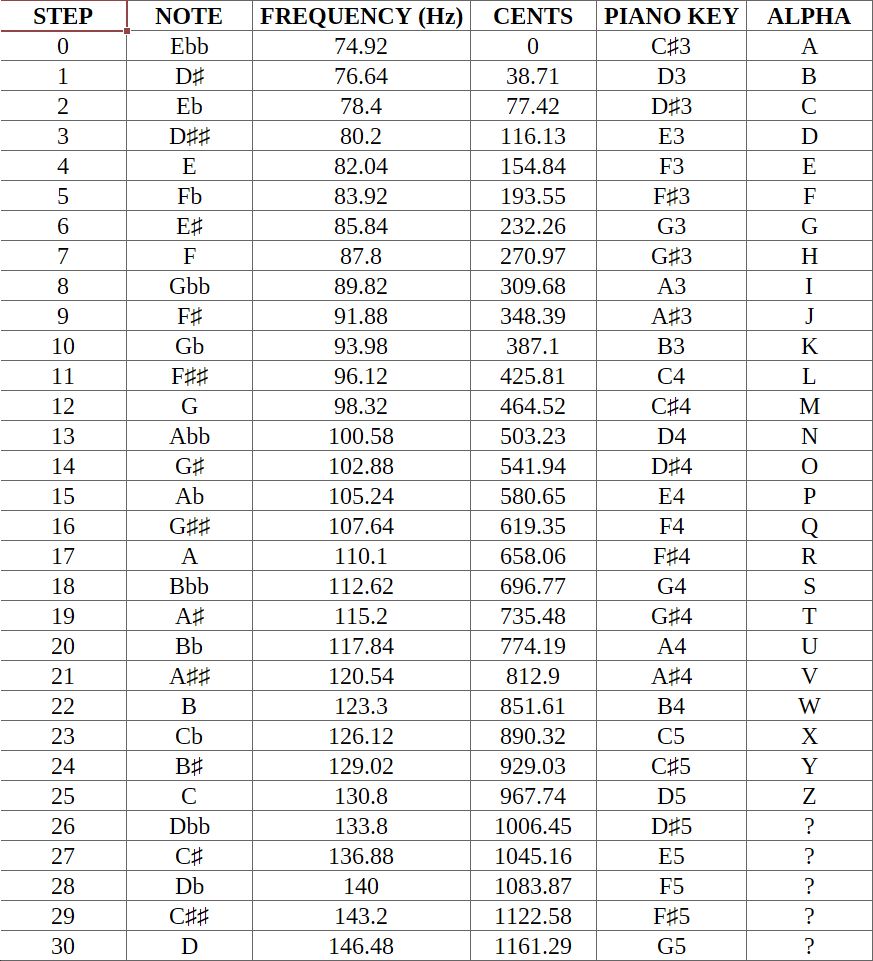
The musical note naming convention in 31-EDO looks unusual, with some double flats and double sharps, and even some note letters that appear to be out of order. This is basically because there are so many notes to name — 31 within each octave.
In my list I’m starting at the alphabetic letter A or “Ebb” or 74.92 Hz to clearly show the alphabetical correspondence to frequencies. This frequency range would be most useful for an upper bass sound. For deep sub basses I can simply tune my synths down a complete octave, and they will still play 31-EDO intervals. This will allow me to create a deep bassline like the classical “electronic” music of the 21st century in which sub-bass lines occupy a range starting at a lower limit of about 40 Hz, around a “D” in 12-EDO tuning. Coincidentially, the 31-EDO note “D##, or 40.1 Hz, happens to correspond to the alpha letter “D”.
The 31-EDO notes, frequencies, “cent” tuning increments, and physical piano keys all reflect physical reality. The SRI system somehow, in some manner I don’t pretend to understand, assigns the letters to various frequencies within each octave. Each octave has the same corresponding alpha letters for the notes within the octave.
As the 31-EDO notes proceed up the physical piano keys one by one, ignoring the keys’ usual correspondence to the 12-EDO system, such a great number of physical keys are used up that it is necessary to think of an extremely long piano keyboard that gets up into keys that would be unrealistically high under 12-EDO tuning, and would not exist on a real piano keyboard. That’s why Vicentino built his special harpsichord with its very large number of keys.
With each higher octave the frequencies are simply double the previous octave’s frequencies.
I can use these notes to make the required melodies, and then tune my instruments up or down by full octaves to ensure the sounds are hitting the right notes in whatever octave I need to create bass or melodic lines, without disturbing the 31-EDO intervals to produce the desired letters.
I’m amused to find that the system is not musically confusing, because in my untrained habit of creating “melodies” using continuous pitch bending, I tend to look at the frequencies more than the notes, creating sounds meant to hit unoccupied frequencies so they are not obscured or masked by other sounds.
But now, here I am composing by using actual notes, in 31-EDO tuning.
In my SRI experiments I find that during playback, “letters” in higher octaves take precedence over letters in lower octaves that hit at the same time. For example, I can compose a bass line that produces certain letters, but if there is a melodic line on top, in a higher octave, the letters picked out by notes in the upper octave take precedence.
There are five leftover notes at the top of the octave (31 notes being 5 more than the 26 letters of the alphabet) that seem to generate either blanks or random letters, as far as I can tell. It’s possible for me to avoid those notes until I figure out what they do. They’re so close to each other in pitch that they don’t eliminate a very significant musical range, at least for the kind of music we’re producing.
In a way, I will be composing the way the Medieval and Renaissance composers did, avoiding certain notes that didn’t work, in their case because of the “wolf” interval, and in my case because I don’t know what the frequencies beyond “Z” will produce, or at least I don’t have time to figure it out through trial and error.
The rhythm of the pitched notes, as well as rhythm and sound of percussion, also have effects that I don’t yet understand. The percussion sounds seem to change or erase letters in the mental image, based on their timing. Fortunately in this minimal style of music, the rhythms are based around the simple 4x4 kick pattern, and the simpler the rhythms can be while still creating a hypnotic groove, the better the music sounds. It would be interesting to see how more complex rhythms like two-step or shuffling beats would affect things, but fortunately I don’t have to worry about that right now. We’re trying to make straight-ahead 4x4 dance music for the festival.
I wonder: In the future, what will artists call this art of injecting language into the music? To me it’s effectual use of pitch and rhythm to create alpha letter patterns. Maybe “Effectual Pitch & Rhythm,” or something.
I believe this is real. What I’m doing here isn’t some kind of delusion. I understand it just well enough, I think, to try to control the letters in the music. I’ll need to experiment with the rhythms, using trial and error until I get it under control.
Assuming I do somehow get the cipher CAMUEL FIVE NO ONE YES embedded into a piece of music, the question remains: how will I get listeners to use the cipher to interpret the JFoxe text? How will I get them to look at it and apply the cipher?
Once again I’m surprised by the simplicity. I can easily hit notes that correspond to alphabetical letters.
The question is: can I make it sound like passable music?
I’ve put together a 4x4 beat in an adequate imitation of the style of the old 21st century classical techno. There was a sub-genre of the style that embraced an extremely stripped-back, minimal or austere sound, with the minimum possible melodic elements to achieve a hypnotic rhythmic groove. If it sounded too melodic, it didn’t sound right.
Quite a bit of our modern music today actually imitates that old style, with an emphasis on the abstract, otherworldly sounds our newer technology can produce.
I think it’ll be hard for me to make melodies that are as minimal as I’d like, because I need to hit a number of notes in fairly rapid succession in order to produce the letters I need. To start, I’m going to simply spell “CAMUEL” with a bass sound, and see how it turns out. In my 31-EDO-Alphabetical chart, these letters correspond to the following notes:
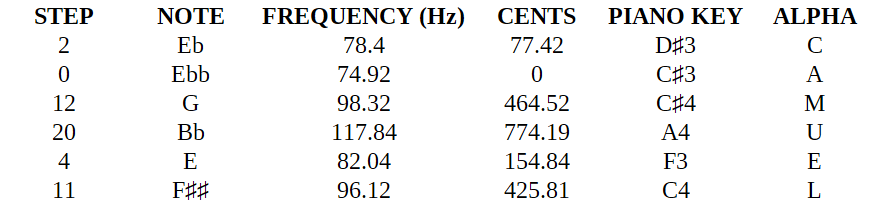
Right away I recognize a problem. The kick drum includes a sub bass note that is “F” in 31-EDO tuning, or 44 Hz. In my chart of 31-EDO vs Alpha letters in the octave below this, I see that this should produce the letter “H”, and sure enough it does. So the letters I get during audio playback are interrupted by a series of H’s. I figure out that putting certain percussion sounds over notes can mask the letter or give a “blank”. If I make the “click” sound of the kick drum loud enough over this 44.1 Hz note, it erases the letter.
So I’m back to simply spelling out CAMUEL with the bass notes. In this style of music the bass notes generally don’t coincide with the kick drum. I then tune the synth down one full octave to get the bass into the sub-bass range, maintaining the 31-EDO intervals.
I am surprised by the result. It’s good enough to get me started. By carefully designing the bass sound — which simply means several hours spent fiddling around with synth settings and effects — the melody sounds surprisingly not too bad. I can play with the timing of the notes without disturbing the language effect. It sounds bouncy and oddly cheerful, but I can transition it to a more serious techno sound in the “normal” part of the song.
(Author’s note: Entering the above notes in a 31-EDO tuned synth in the digital audio workstation Bitwig Studio actually gave a passable bass melody.)
As I listen, my eyes lose focus for an instant, and I feel momentarily stunned. I’ve been expecting the usual torture to start any time now, but this is different. There was no electric sensation, no burning or pain. Just a momentary feeling like I blanked out, and I couldn’t see for a second or two. I think I must have fallen asleep briefly as I’m very sleep deprived.
Next I map the rest of the letters, “FIVE NO ONE YES”.
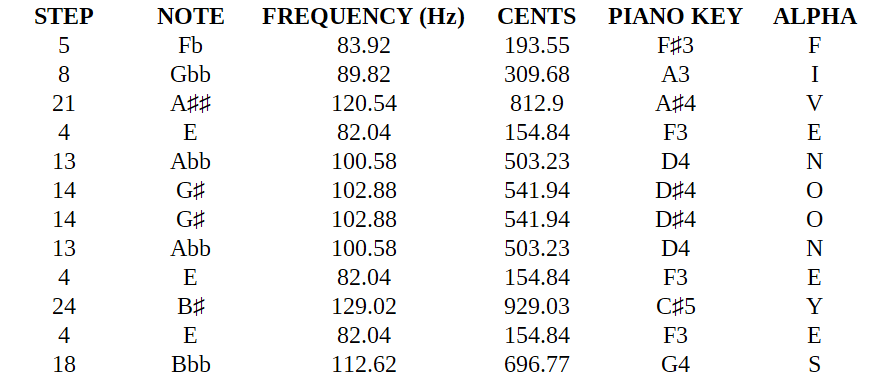
I do it the same way, using the same octave and then setting the synth to play in a higher octave. I set it on top of the bass sound. This time, it sounds a little too weird, not in the good way. But after experimenting with different sounds, and using a different sound for one of the notes, I am getting it to sound somewhat acceptable. If I arrange it carefully, I can use it as a weird intro section before a more normal sounding section comes in.
(Author’s note: Entering the above notes in a 31-EDO tuned synth the digital audio workstation Bitwig Studio created a strange-sounding but passable upper melodic part.)
I’ve done it. It shouldn’t matter what comes next in the song, as long as the listeners hear the intro part. I’ll bring it in again quickly as a kind of breakdown and buildup, so listeners hear it again.
I listen to it as plain audio, no SRI, neurotech engaged. And sure enough, I see the entire cipher: CAMUEL FIVE NO ONE YES.
Again I blank out for a second or two. Damn it, I’ll have to get outside and sleep for a while.
I take a break from tweaking the sounds and look through my messages from Gryffe. He’s been sharing a lot of tips about sound production over the past week or so, especially teaching me how to get everything to sound loud and crisp so it holds up when it’s played in a live set.
This text I’m reading is about creating a smooth kind of distortion on a bass sound, by driving deep bass along with some white noise into an overdriven filter to get this soft yet crisp, papery distortion that emphasizes the shape of the bass sound and makes it sound like it’s at the front of the mix. Without all Gryffe’s help there’s no way I’d be able to make the music sound good enough. I am puzzled by the fact that Gryffe has been so generous with his time. He seems genuinely excited to help me.
While I’m reading, I press play and listen to the audio again, looped so that it repeats. As soon as the intro section of the song is almost complete, I get that stunned feeling again. When I regain focus I’m startled by what I see on the display.
The words and letters I’m looking at appear all jumbled like nonsense. This long text from Gryffe has turned into a much shorter block of letters that make no sense. What is happening? Is my workstation malfunctioning? Alarmed, I stop the music.
The letters go back to normal. I’m once again looking at Gryffe’s text.
I press play again and the music starts. After the first loop is about complete, the letters all turn to the short block of nonsense again. I stop the music. The letters go back to normal.
Is the cipher working somehow, trying to decipher any text I look at? No way. That’s not possible. I must really be hallucinating.
But I repeat it a few times, with other examples of text, and it works the same way every time. It only works when the music is playing. Is it actually picking out every sixth letter, as the cipher intends?
I immediately think of looking at the JFoxe text. Will it be deciphered? Should I look at it?