Ch 23: Spirit Ciphers
~
(David)
I’m alternating working on my research into this 15th century monk Trithemius, and experimenting with the SRI’s ability to create letters in my mind. I’m not sure which results in the worse torture.
I’m still thinking about the controversy regarding Trithemius. The cryptography experts didn’t concern themselves with this controversy, but other people certainly did.
He created the controversy himself, in the method he employed to teach his system of steganography: He taught it by writing about how to conjure spirits.
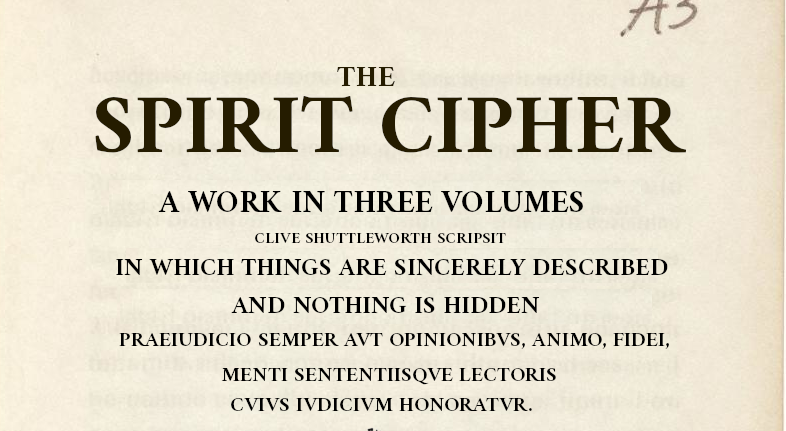
He hid his demonstrations of steganography within writing that, on its face, described methods of using certain named “spirits”, who mainly seem to be angels, but some would call demons, to assist with the encryption and sending of messages.
Trithemius instructs the user to write any innocuous cover message (covertext), then conjure a specific spirit by properly saying the provided conjuration while doing other very specific things such as facing in a certain direction at a specific time of day or night. The conjurations would have to be performed perfectly in order to work. The spirit would then appear, and after the user reveals his true intended message (the plaintext) to the spirit, the spirit would obediently take the covertext to the recipient. Finally, if the recipient properly performed the conjuration (presumably shared by the user, like a key), they would see the true plaintext message.
Trithemius said that the steganographic methods he described were meant for, and perhaps could only be properly used by, morally and spiritually worthy people.
I enjoy Trithemius’s formal, clear writing:
It is the opinion of the learned that whenever the ancient sages, whom in the Greek language we call Philosophers, discovered any secret of art or nature, they concealed it through various modes and figures lest the knowledge of it should fall into the hands of the wicked.
…[similarly the] erudite philosophers and poets who, through a deeply wise invention, endeavoured when composing their fables to relate in a single narration one thing to the ignorant and another to the learned.
Trithemius wrote about the importance of limiting access to his methods to “good men and lovers of honesty” and preventing their use by “slithering perverts and criminals”.
Book I of Steganographia consists of 31 chapters, each dealing with one of 31 “Aerial” or “Chief” spirits (under which thousands of other spirits operated), plus one more chapter at the end that appears to be a kind of summary, for a total of 32 chapters. Each of the 31 spirits represents one method or “key” to hiding and then deciphering the plaintext of a message. It seems that under each method, it is possible for the user to create many variations using the method’s basic concept.
Each method or key shows the recipient how to pick out letters from the covertext to arrive at the hidden plaintext.
Regarding one of these “spirit” ciphers, called “Padiel”, as well as its variants or subordinate spirits, Trithemius wrote:
“All these spirits are good and benevolent, nor do they harm the operator unless he is malicious or less skilled in the art…No one evil or malicious will be able to operate with this art, but the more someone is good and pure, the more the Spirits will obey him willingly and cheerfully…Note also that this Padiel [the spirit]…has been charged with announcing secret advice for the correction, imprisonment, and punishment of malefactors…”
A good, honest, cheerful, obedient “spirit” that only works for someone who is good and pure, and is designed to help with the correction, imprisonment, and punishment of malefactors. I think with a chuckle: Great, what could possibly go wrong?
I do know that Trithemius was writing about methods of securing hidden messages. But still, no way am I going to recite any conjuration while facing east at sunrise or whatever. Call me superstitious, but I don’t need to mess with that. I have enough problems as it is.
I think that in emphasizing the required goodness and purity of the user, Trithemius was mainly warning that these cryptographic methods should be concealed from anyone other than his powerful elite patrons such as the Holy Roman Emperor Maximilian I. He clearly warned them that this new technology he’d created would be dangerous if it fell into the wrong hands, such as enemies of the state.
I think that by couching the work in terms of “spirit conjuring”, Trithemius was simply making sure that the methods would not be available to the general public or to enemies. The knowledge was wrapped up in an illicit-looking package about angelic and maybe demonic spirits. Maybe when the Roman Church later banned Steganographia, that merely helped to preserve it as an elite-only, allies-only cryptography technology.
Maybe all this helps explain why Trithemius never got burned at the stake by the Inquisition. I don’t know. I haven’t been able to spend enough time to really understand it all.
But I must admit it is kind of odd that Trithemius, a Benedictine monk and abbot, owned an extraordinarily extensive library of magic and occult literature.
The controversy about him is fascinating.
But I’m in pain again. It’s not pain exactly. It’s the feeling of an electric current that does not quite reach the level of pain, until it does of course. Then it starts to burn. I have to get out to the park for a while. It’s so frustrating. I could do my research twice as fast if I didn’t have to keep leaving my apartment.
On the way out to the park I stop off to pick up something to eat. I remember to get real food. A real sandwich made for me at a deli, an apple and a banana. And a bottle of real primary spring water. It’s shockingly expensive to eat healthy but I promised myself I would do it.
While I’m in the deli I notice that I’m behaving cautiously around people. Minimizing conversation, never sharing information, avoiding basic pleasantries. After experiencing several weird and puzzling interactions with strangers, I’m cautious. I worry about this a bit. It mirrors the behaviour of someone who’s experiencing unhealthy paranoia. I can’t help it though.
I arrive back at my apartment feeling somewhat upbeat. I avoided the worst of the pain, got a bit of sleep in the park, and ate real food. I’ll make a coffee and get back to work.
I open the cupboard in my kitchen and stop dead. I’m looking at the pack of ground coffee sitting there on the shelf where I always keep it.
It’s a different brand of coffee.
I know I didn’t buy a different brand of coffee. I always buy the same coffee. Not the best coffee, but the price is right. This is not that brand.
This is so disturbing. Someone has somehow entered my apartment and, rather than stealing or vandalizing, they—changed my coffee brand? Who would I even complain to about this?
I try to convince myself that I must have bought a different brand without noticing. But the package is open and apparently partly used. I would have noticed it when I opened the package.
I throw out the coffee and decide to get back to my workstation and just do the work.
As I turn I freeze again. My shoes over by the door. Four different pairs of shoes for various purposes: shoes for the office, shoes for when it’s wet out, casual shoes, and I’m still wearing my running shoes. But the shoes are all lined up neatly by the door. I never line up my shoes neatly like that. I’d like to be the kind of person who does that, but I’m just not. They’re usually in a haphazard pile.
Okay, someone’s definitely fucking with me. There’s nothing I can do about it. Keep working.
The work. Oh shit, what was on my workstation when I left it? What have they seen?
But I wasn’t doing anything illegal or illicit. I was just doing my sabbatical work.
I’m being messed with. I can’t tell anyone about it because they’d think I’m crazy.
Back to work. Trithemius.
When was his book written? Right, T-1499. But throughout the 1500s, it was distributed only privately in manuscript form, during which time it was, probably mistakenly, interpreted as a grimoire, a manual for conjuring spirits – albeit as a means of transmitting private encoded messages to an intended recipient over long distances.
For the rest of his days, Trithemius was—perhaps wrongly—branded with the reputation of being a sorcerer or black magician.
T-1499 was finally printed and widely published in 1606, long after Trithemius’s death, along with a Clavia or key showing clearly that its first two volumes, Books I and II, were in fact manuals demonstrating methods of steganography or cryptography.
Still, the Roman Catholic Church quickly classified the book as dangerous occult literature and placed it on the Index Librorum Prohibitorum (the Index of Prohibited Books) which forbade Catholics from possessing or reading works deemed heretical or morally harmful. It remained on the Prohibited list until 1900, by which time Trithemius’s work had begun to be recognized more broadly as cryptography rather than necromancy.
It was not until around 1993—500 years after T-1499 was written—that Book III was solved as a cryptographic text. This finally contradicted the widely held belief that while Books I and II were cryptography, Book III was purely about magic. [1]
But Steganographia always continued to be treated as having a dual purpose. On one hand, it was a grimoire or manual for conjuring angelic or perhaps demonic spirits. On the other hand, the work clearly demonstrated steganographic and cryptographic techniques, independent of any spirit conjuring.
These techniques continued to be taught to computer science students (as history) well into the 21st century.
And well into the 21st century, scholars debated which of these purposes Trithemius himself viewed as the true one. Is it just cryptography, or is it a grimoire?
I’m chuckling at how fascinating this is: Trithemius cleverly hid his systems of cryptography with meta-cryptic writing that was performative of the concept. He hid a message, about hiding messages within other messages, within another message.
Trithemius seemed, at least to my modern mind, to defend the “it’s just cryptography” stance in the introductory words of T-1499, in which he strenuously emphasized his Christian orthodoxy and loyalty to the Roman Church.
He also wrote in opposition to black magic and witchcraft. For example, in his Antipalus Maleficiorum (“Adversary of Black Magic”), written in 1508 but not published until 1605, he listed and denounced 43 demonic/necromantic books, placing the Clavicula Salomonis (Key of Solomon) near the top of the list, describing it as a “worthless, foolish sham” and a spurious forgery.
Nonetheless, Trithemius’s structural framework for organizing hierarchies of spiritual entities became embedded in later occult literature, possibly including darker or demonic materials, and eventually filtered into the popular understanding of angelic and demonic hierarchies. The 17th-century _Lemegeton, _often referred to as the Lesser Key of Solomon, an anonymously compiled collection of grimoires, incorporated Trithemius’s angelic “31 Aerial spirits” system in its second and third books, the Ars Theurgia Goetia and the Ars Paulina. (However, the first book, the Ars Goetia, set out a system of 72 spirits that seem to be of the dark, demonic, dangerous type.)
In Renaissance Europe, goetia was generally considered evil and heretical, unlike _theurgia _(theurgy) and _magia naturalis _(natural magic) which were widely considered good or noble. It seems that Trithemius’s 31 spirits were thought to be more angelic or “good” in nature, rather than purely demonic.
For centuries, historians of ancient, Renaissance and modern occult and magical practices, if they knew the name Trithemius, would commonly associate it with the systematic listing and ranking of angelic or demonic spirits.
Some see the use and development of Trithemius’s system of spirits in occult practice as a kind of ironic mistake that resulted in a massive, long-lasting cultural influence.
Some disagree, believing that Trithemius, and the occultists who succeeded him, knew more than they were willing to explain to the uninitiated.
I can see why the Christian Church would regard Trithemius’s writings as possibly dangerous, providing, as they do, express instructions on the conjuring of spirits. Deuteronomy 18 of the Christian Old Testament (the Hebrew Bible) clearly states that God regards as abominations the acts of divination, soothsaying, interpreting omens, sorcery, spell casting, mediumship, spiritism, or consulting the dead.
Yet both the occultists and the Christians historically would have had to acknowledge the reality (if they were aware of it) that Trithemius’s writings were expressly about steganography and cryptography.
[1]